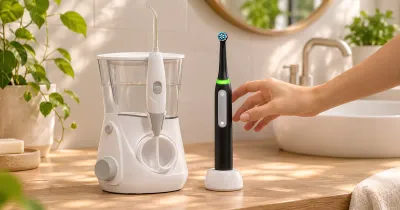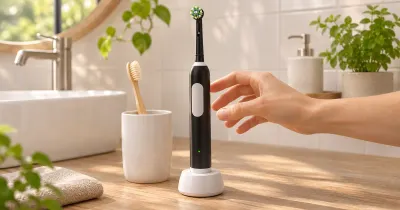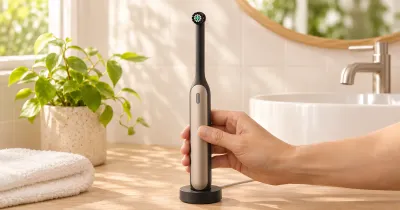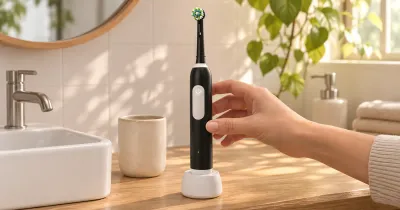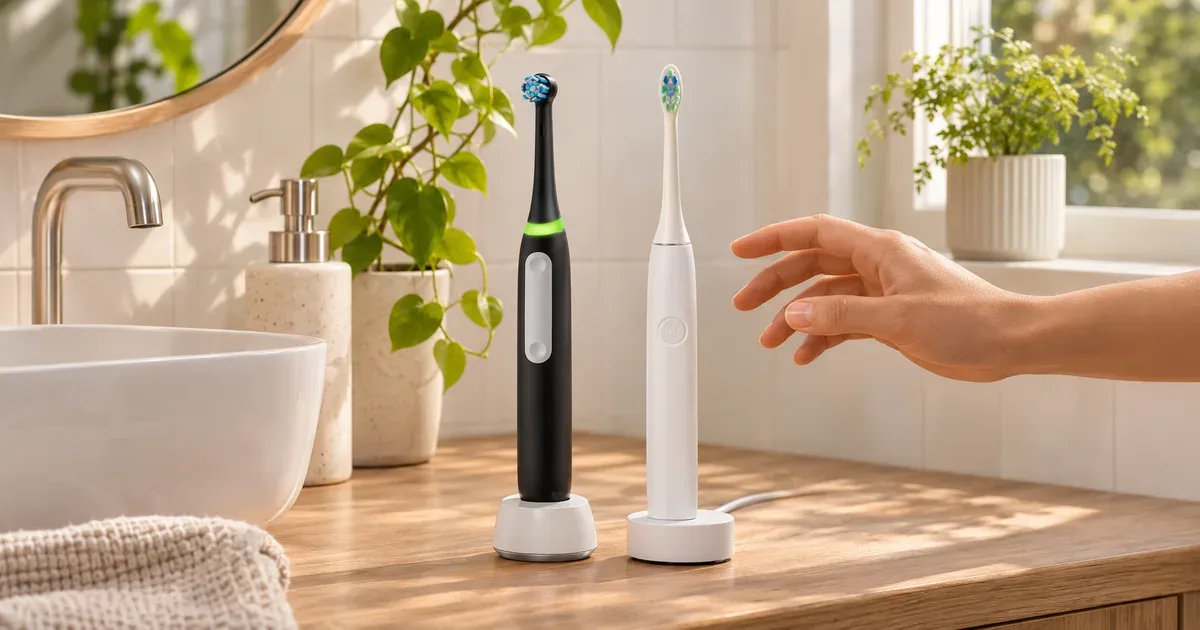
Oscillating-rotating brushes, the round-headed type Oral-B makes, remove slightly more plaque than sonic brushes in every recent systematic review, but the difference is small: a 2022 network meta-analysis rates it a “very small” benefit with moderate certainty. Both types clean better than a manual brush. Choose oscillating-rotating if you want the type with the most evidence, such as the Oral-B iO Series 3 ($59.99 on Amazon on November 24, 2026). Choose sonic if you prefer a gentler feel and a longer published battery, such as the Sonicare 4100 ($29.96).
How They Move
- Oscillating-rotating: a small round head turns back and forth around its center, cupping one tooth at a time. Oral-B’s iO models add “micro-vibrations” from a magnetic drive. quip’s Rev brushes are also oscillating (“rotates & pulsates”).
- Sonic: an oval head sweeps side to side at high frequency. Philips rates its rechargeable adult Sonicare models at 62,000 brush movements per minute. Burst, quip’s Sonic and Ultra models, and most budget brushes are sonic.
What the Research Says
| Review | What it compared | Result | Certainty |
|---|---|---|---|
| Thomassen, Van der Weijden, Slot 2022 | Network meta-analysis, single brushing | Oscillating-rotating had a “very small” benefit over high-frequency sonic | Moderate |
| van der Sluijs et al. 2023 | 38 comparisons from trials of 4 weeks or longer | Oscillating-rotating beat sonic significantly in 54% of comparisons; plaque-index difference 0.13 (95% CI 0.05 to 0.21) | “Small but significant” |
| Clark-Perry & Levin 2020 | 12 randomized trials | Oscillating-rotating better for whole-mouth plaque; “some evidence” of more plaque removal and less bleeding | Limited |
| Luo et al. 2026 | Network meta-analysis, 19 randomized trials | Plaque ranking (SUCRA): oscillating-rotating 89.2%, sonic 72.4%, ultrasonic 54.1%, manual 18.3%; similar for gingivitis | Low risk of bias |
For context, the 2014 Cochrane review of 56 trials found powered brushes of all kinds removed 11% more plaque in the short term and 21% after 3 months, and cut gingivitis by 6% and 11%, with moderate-quality evidence. Rotation-oscillation brushes had the most trials and a significant benefit at both time points (PubMed 24934383).
Two caveats. The 2023 review’s authors include long-time Oral-B study investigators. And a plaque-index difference of 0.13 on a 0-to-5 scale is small; the reviews show a consistent direction, not a large gap.
What no review covers
No systematic review compares the two types for sensitive teeth, whitening, gum recession or comfort. A 2026 review found no difference in gum recession between powered and manual brushes (very low certainty), and none separated oscillating from sonic (PubMed 42071338). “Feels gentler” is a preference, not a finding. Maker claims like “up to 300% more plaque” (Oral-B) or “up to 20x” (Philips) come from the makers’ own studies against a manual brush and can’t be compared with each other.
Spec Comparison
| Oral-B Pro 1000 | Oral-B iO Series 3 | Sonicare 4100 (HX3681/23) | Sonicare 5950 (HX7130/03) | |
|---|---|---|---|---|
| Motion | Oscillating-rotating | Oscillating-rotating + micro-vibrations | Sonic | Sonic |
| Modes | 1 (Oral-B Gum Care page); 3 (Amazon listing) | 3 | Clean, 2 intensities | Clean, Gum Health; 3 intensities |
| Pressure sensor | Stops pulsations | Visible alert | Vibrates handle | Haptic pulse |
| Timer | 2 min, 30-s pulses | 2 min, quadrant pacing | QuadPacer + SmarTimer | BrushPacer (20 s) + SmartTimer |
| Battery (maker) | Not published | Not published | 14 days | 21 days |
| Charger | Stand | Charger | Charger, no power adapter | USB charger, no power adapter |
| Travel case | No | Yes (Amazon kit) | No | Yes |
| App | No | No | No | No |
| Heads included | Not stated on Amazon | 2 | 1 C2 | 2 C3 |
| Head cost per year | $20 to $27 | About $30 | $23 to $30 (C2) | $23 to $30 (C2) |
| ADA Seal | Oral-B technology listing | Yes | No | No |
| Amazon, Nov 24, 2026 | $49.94 | $59.99 | $29.96 | $59.96 |
The Sonicare 5950 is Amazon’s name for an HX7130 kit with two heads and a travel case; Philips sells the HX7130 as the Series 5700 for $64.96 on its own store. Head costs assume one head every 3 months at maker-store pack prices.
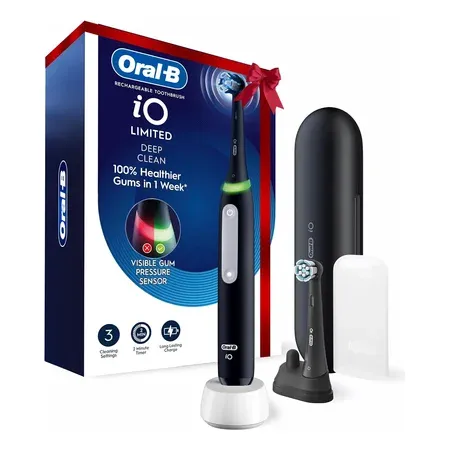
Best Oscillating-Rotating brush for most people
Oral-B iO Series 3
3 modes, a visible pressure alert, 2 heads and a travel case. ADA Seal (iO Series). $59.99 on Nov 24, 2026.
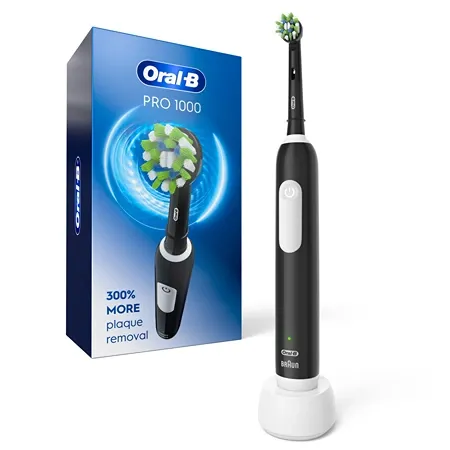
Simplest oscillating brush
Oral-B Pro 1000
Round oscillating head, pressure control that stops pulsations, and the cheapest Oral-B heads. $49.94 on Nov 24, 2026.
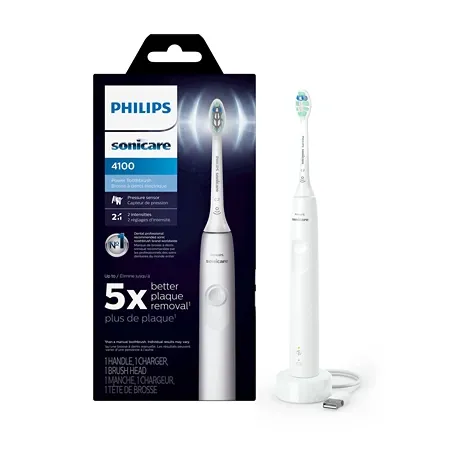
Best cheap sonic brush
Philips Sonicare 4100 (HX3681/23)
2 intensities, a vibrating pressure alert and a 14-day battery. $29.96 on Nov 24, 2026.
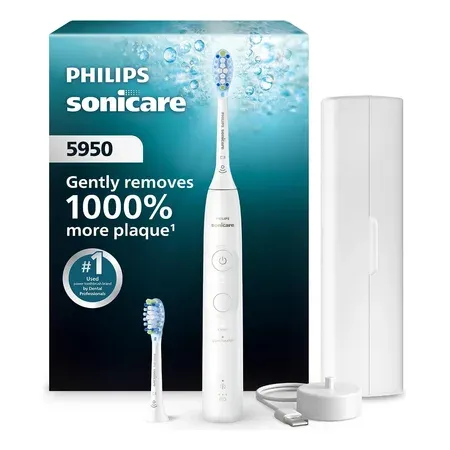
Sonic brush with a 21-Day battery
Philips Sonicare 5950 (HX7130/03)
Clean and Gum Health modes, 3 intensities, a haptic pressure alert, 2 heads and a travel case. $59.96 on Nov 24, 2026.
Which Type to Choose
- You want the type with the most evidence: oscillating-rotating. The edge is small but consistent across reviews.
- You find a spinning head harsh or noisy: sonic. You give up a small amount of measured plaque removal, not the benefit over a manual brush.
- You want the ADA Seal: Oral-B. No Sonicare brush is on the ADA list. quip’s non-rechargeable sonic brush is.
- You travel a lot: sonic models publish 14 to 21 days per charge; among Oral-B iO models only the iO Series 2 publishes a figure (4 weeks).
Brand by brand, see Oral-B vs. Philips Sonicare. For whether either type can hurt your gums, see can an electric toothbrush damage your gums.
Sources
- Cochrane: powered vs. manual toothbrushing (PubMed 24934383)
- Thomassen et al. 2022 (PubMed 34877772)
- van der Sluijs et al. 2023 (PubMed 35535635)
- Clark-Perry & Levin 2020 (PubMed 32111341)
- Luo et al. 2026 (PubMed 42234020)
- Molina et al. 2026, gum recession (PubMed 42071338)
- Oral-B iO Series 3
- Oral-B Pro 1000 Gum Care
- Philips Sonicare 4100 Series HX3681/23
- Philips Sonicare Series 5700 HX7130/01
FAQ
Is oscillating or sonic better?
Oscillating-rotating removes slightly more plaque in four systematic reviews, with moderate certainty for a “very small” difference. Both beat a manual brush.
Is Sonicare oscillating or sonic?
Sonic. Philips Sonicare heads move side to side, at 62,000 brush movements per minute on rechargeable adult models.
Is Oral-B oscillating or sonic?
Oscillating-rotating. Every Oral-B electric brush uses a round rotating head, and iO models add micro-vibrations.
Are sonic toothbrushes gentler on gums?
No review shows that. A 2026 review found no difference in gum recession between powered and manual brushes, and none compared sonic with oscillating for gum damage.