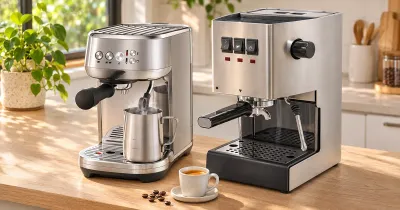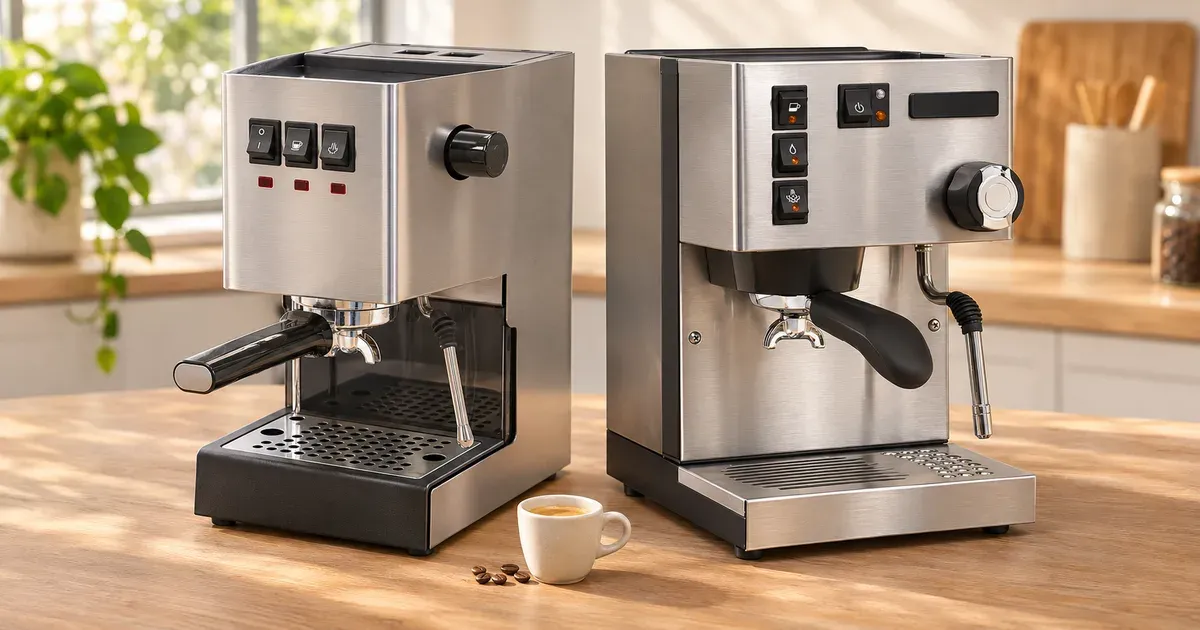
The short answer: buy the Gaggia Classic Pro E24 if you mostly drink espresso and want the best value in a 58 mm machine, and the Rancilio Silvia if you make two or three milk drinks in a row and want a heavier machine with more steam. Both are single-boiler machines from Italian makers with commercial-size 58 mm portafilters, vibration pumps, thermostat temperature control and manual steam wands, and both need a separate grinder. The Silvia’s 0.3-liter boiler holds about three times as much water as the Gaggia’s 3.5 oz boiler, which is what you pay for: steam that lasts longer through a big pitcher of milk.
Prices on November 16, 2026: the Gaggia Classic Pro E24 is $449.76 on Amazon ($549 for stainless on gaggia-na.com, $599 in colors) and the Rancilio Silvia is $995 on Amazon.
Gaggia Classic Pro vs. Rancilio Silvia at a Glance
| Gaggia Classic Pro E24 | Rancilio Silvia | |
|---|---|---|
| Model | RI9380/46 (stainless) | Silvia (Amazon lists it as Silvia M V6) |
| Price, Nov. 16, 2026 | $449.76 Amazon, $549 Gaggia | $995 Amazon |
| Boiler | Single, lead-free brass, 3.5 oz | Single, 0.3 liter (about 10 oz) |
| Heating element | 1,370 W | 950 to 1,000 W total at 120 V |
| Temperature control | Thermostat | Thermostat, manual regulation |
| Pump | 15-bar Italian Ulka vibration pump, OPV set to 9 bar | Vibration pump |
| Group | Commercial style | Brass |
| Portafilter | 58 mm, chrome; baskets for 7 to 18 g | 58 mm, chrome-plated brass; holds up to 21 g |
| Pressure gauge | No | No |
| Steam wand | Commercial-style, 2-hole tip, rotating, insulated grip | Stainless, steam knob |
| Water tank | 72 oz | 2 liters (68 oz) |
| Size (W x D x H) | 8 x 9.5 x 14.2 in. | 9.3 x 11.4 x 13.4 in. |
| Weight | 19 lb | 30.8 lb |
| Total power | 1,425 W | 950 to 1,000 W |
| Grinder | None | None |
Gaggia specs are from gaggia-na.com and Rancilio’s from its Silvia page, both read November 16, 2026.
Classic Evo Pro, Classic Pro, E24: Which Gaggia Is Current?
Gaggia North America now sells one Classic: the Classic Pro E24, which it calls “the newest version” of the machine, built around a solid lead-free brass boiler. It replaces the Classic Evo Pro, and before that the Classic Pro, in Gaggia’s lineup. Gaggia sells the same 2024 brass boiler as a replacement part and lists it as fitting the Classic, Classic Pro and Classic Evo Pro, so the boiler is the main change. If you’re shopping on Amazon, the E24 in brushed stainless is model RI9380/46. Used and older stock listed as “Evo Pro” won’t have the E24’s brass boiler unless someone swapped it.
The Rancilio Silvia has gone through several versions too. Retailers call the current one the V6 or Silvia M; Rancilio’s own page calls it simply Silvia. Rancilio also sells the Silvia Pro X, a different machine with two boilers and two PID controllers ($2,195 on Amazon).
Boiler and Steaming: The Silvia’s Real Advantage
Both machines use one boiler for brewing and steaming. You pull the shot, flip the steam switch, wait for the boiler to climb to steam temperature, then steam. Neither can brew and steam at the same time. For how that compares with heat-exchanger and dual-boiler machines, see single boiler vs. dual boiler vs. heat exchanger.
The difference is volume. The Silvia’s 0.3-liter boiler holds about 10 oz of water; the Gaggia’s holds 3.5 oz. A larger boiler stores more steam before the pressure sags, so the Silvia can texture a full 12 oz pitcher or two drinks back to back with less waiting. The Gaggia steams a single latte’s worth of milk well with its two-hole commercial tip, then needs a moment to recover. If you only make one milk drink at a time, that difference is small. If you host or make drinks for two every morning, it’s the reason to pay more.
Espresso: Closer Than the Price Gap
For straight espresso, the two are closer than the $545 price gap suggests. Both have 58 mm portafilters, the size cafés use, so tampers, baskets and bottomless portafilters are easy to find. Both use thermostats rather than PID controllers, so brew temperature rises and falls within the thermostat’s range, and both have vibration pumps. Gaggia sets its overpressure valve to 9 bar, the standard espresso brew pressure, and lists baskets from 7 to 18 g. Rancilio’s portafilter takes baskets up to 21 g.
Neither machine is forgiving the way a Breville is. There’s no pre-infusion program, no automatic shot volume and no PID, so grind size, dose and tamp all show up in the cup. That’s the appeal for people who want to learn espresso properly, and the drawback for anyone who just wants a latte.
Build and Size
The Silvia is the heavier machine: 30.8 lb against 19 lb, with a brass group and a chrome-plated brass portafilter. It’s also wider and deeper (9.3 x 11.4 in. versus 8 x 9.5 in.). At 8 in. wide, the Gaggia fits a crowded counter more easily, and its 72 oz tank is a little larger than the Silvia’s 2-liter one.
Both are simple machines built around rocker switches, a thermostat and a vibration pump, with no screens or shot programs to fail. Gaggia sells parts such as the boiler, group gasket and portafilters on its own site. Gaggia designs and builds the E24 in Gaggio Montano, Italy.
Which Should You Buy?
- Buy the Gaggia Classic Pro E24 if you want a real 58 mm espresso machine for under $550, mostly drink espresso or one milk drink at a time, and have limited counter space. The money saved buys a good grinder.
- Buy the Rancilio Silvia if you make several milk drinks in a row and value a heavier, larger-boilered machine enough to pay about twice as much.
- Look at the Silvia Pro X or another dual boiler if you want PID temperature control and to brew and steam at once; at $2,195 it’s a different class of machine.
- Look at the Breville Bambino Plus if you’re new to espresso and want a machine that does more of the work. We compare it with the Gaggia in Bambino Plus vs. Gaggia Classic Pro.
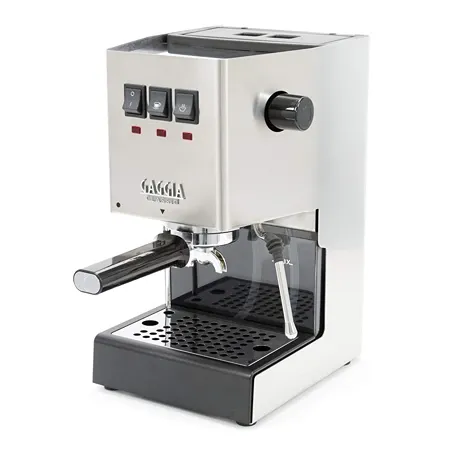
Best value 58 mm espresso machine
Gaggia Classic Pro E24
Single brass boiler, 58 mm portafilter, 9-bar OPV and a commercial-style steam wand. Made in Italy.
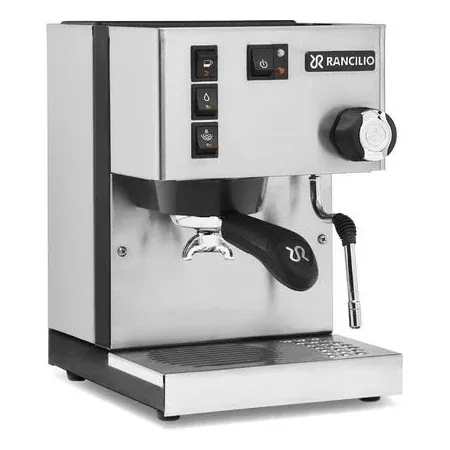
Best for back-to-back milk drinks
Rancilio Silvia
0.3-liter boiler, brass group, 58 mm chrome-plated brass portafilter and a 2-liter tank.
You’ll Need a Grinder
Neither machine has a grinder, and both need a burr grinder that can grind fine enough for unpressurized espresso baskets. The usual choices around $200 are the Baratza Encore ESP and the Breville Smart Grinder Pro; we compare them in Smart Grinder Pro vs. Encore ESP. For more machines at every price, see our guide to the best home espresso machines.
Gaggia Classic Pro vs. Rancilio Silvia FAQ
Is the Gaggia Classic Pro better than the Rancilio Silvia?
For value, yes: it costs about half as much and pulls espresso with the same 58 mm portafilter, vibration pump and thermostat control. The Silvia is better for steaming, because its 0.3-liter boiler holds about three times as much water, and it’s heavier and more solidly built.
Is the Gaggia Classic Evo Pro good for beginners?
It’s a good machine to learn on if you want to learn espresso properly, but it isn’t easy. There’s no PID, no pre-infusion program and no automatic shot volume, and it needs a capable grinder. The current version is the Classic Pro E24, which replaced the Evo Pro and adds a brass boiler. Beginners who mainly want lattes will find the Breville Bambino Plus easier.
Is the Rancilio Silvia worth it?
It’s worth it if you make several milk drinks in a row and want a heavy, simple machine built to be repaired. At $995 without a grinder, it’s expensive for a single-boiler machine with thermostat control; the Gaggia Classic Pro E24 makes comparable espresso for about half the price.
What is the difference between the Gaggia Classic Pro and the Classic Pro E24?
The E24 is the current version, with a solid lead-free brass boiler. Gaggia sells that 2024 brass boiler as a part for the older Classic, Classic Pro and Classic Evo Pro. The 58 mm portafilter, 9-bar pressure valve and commercial-style steam wand carry over.
Do the Gaggia Classic Pro and Rancilio Silvia have a PID?
No. Both control temperature with a thermostat. Rancilio’s Silvia Pro X has two PID controllers and two boilers, at $2,195.
Can the Rancilio Silvia brew and steam at the same time?
No. Like the Gaggia, it has one boiler that has to heat up to steam temperature after you pull the shot. Machines that brew and steam at once use a heat exchanger or two boilers.