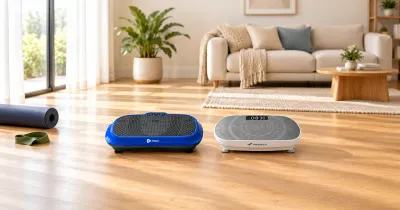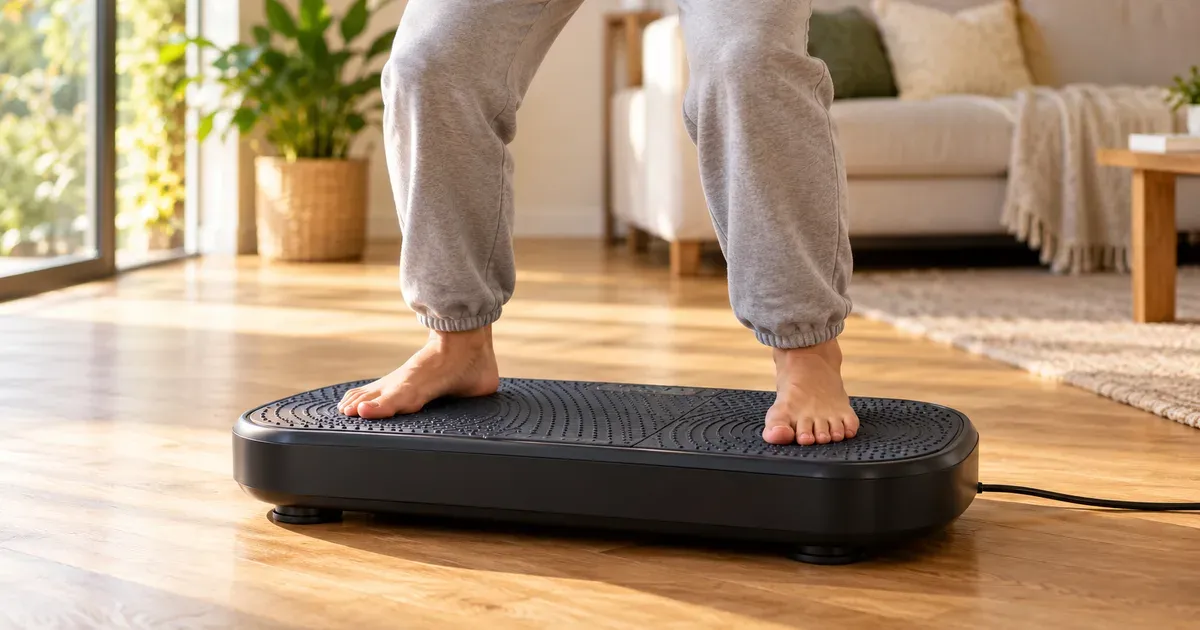
Vibration plates promise a lot: fat loss in 10 minutes a day, lymphatic drainage, smoother skin, stronger bones, and better circulation. You stand on a platform that shakes rapidly, and the vibration makes your muscles contract reflexively, dozens of times a second.
Researchers have studied this for more than 20 years under the name whole-body vibration (WBV) training, and there are now dozens of randomized trials and systematic reviews. The short version:
- It works for leg strength, balance, and mobility in older adults, and it may reduce falls. This is the best-supported use.
- It modestly lowers blood pressure and can reduce back and knee pain, mostly as an add-on to regular exercise.
- It may help bone density a little, at specific settings and over many months. The reviews disagree.
- It does not cause meaningful weight loss on its own.
- There’s no good evidence for lymphatic drainage or cellulite, the two claims most common in ads.
Here’s what the research says about each claim, and what it means if you’re thinking of buying a plate.
Weight Loss: No Meaningful Effect on Its Own
This is the claim behind most vibration plate sales, and it’s the weakest.
The largest recent review, a 2025 meta-analysis in the International Journal of Obesity, pooled 20 randomized trials with 585 people. Vibration training alone had no significant effect on body weight, BMI, fat mass, or body-fat percentage. The one exception was a subgroup of people 50 and older, whose body-fat percentage fell by about 1.8 percentage points more than controls.
A 2021 review in Archives of Physical Medicine and Rehabilitation looked only at people with overweight or obesity (23 studies, 884 people). It found a loss of about 1 kg (2.4 pounds) of fat mass, which the authors called “not clinically significant,” and no change in body weight or BMI.
How many calories does a vibration plate burn? Not many. In a lab study in the European Journal of Applied Physiology, standing on a plate vibrating at 26 Hz raised oxygen use by 4.5 mL per kilogram per minute over standing still. For a 155-pound person, that works out to roughly 15 extra calories in 10 minutes, about what a few minutes of slow walking burns. A 2016 study found vibration raised energy use by 36% over standing, but called the effect “quantitatively small,” under 2 METs. Squatting on the plate burns more than standing on it, mostly because squatting is exercise.
Bottom line: a vibration plate won’t make you lose weight. If you use it for squats, lunges, and other exercises, it’s a low-impact workout like any other, and diet still does most of the work.
Strength, Balance, and Falls in Older Adults: The Strongest Evidence
This is where vibration training has the most consistent results.
- A 2023 review in Archives of Physical Medicine and Rehabilitation of 18 randomized trials in adults 65 and older found improvements in knee strength (standardized mean difference 0.72, a moderate-to-large effect), the sit-to-stand test (0.57), the Timed Up and Go balance test (0.53), and walking speed (0.46).
- A 2024 review in Physical Therapy of 14 trials in nursing home residents over 80 found similar gains in leg strength (0.59), mobility (0.45), and balance (0.41).
- A 2017 review in BMJ Open pooled four trials (746 people) and found vibration training cut the rate of falls by about a third (rate ratio 0.67), rated moderate-quality evidence. The share of people who fell at least once didn’t change significantly.
The largest single trial, published in Osteoporosis International, gave 710 women over 60 20 minutes of vibration a day, five days a week, for 18 months. Falls or fractures occurred in 18.6% of the vibration group against 28.7% of controls.
There’s an important caveat. A 2025 network meta-analysis of 27 trials in older adults, also in Archives of Physical Medicine and Rehabilitation, found vibration training was good for balance and walking, but traditional strength training beat it for building muscle strength. A vibration plate is a reasonable option for people who can’t do regular strength work. It isn’t better than lifting weights.
Bone Density: Small Gains at Specific Settings
The research here is mixed, and the settings matter.
- A 2022 review in Osteoporosis International of 23 studies in postmenopausal women found improvements in lumbar spine and hip (trochanter) bone density. Only one protocol had high-quality evidence: high frequency (about 30 Hz), low magnitude (about 0.3 g), and a large cumulative dose of about 7,000 minutes, roughly 20 minutes a day for a year.
- A 2025 review in PeerJ of seven trials in adults 55 and older found a small effect on total hip density but no significant effect on the femoral neck or spine, with low-certainty evidence.
- The 2017 BMJ Open review found no overall effect on bone density.
Bottom line: vibration might slow bone loss slightly with long, consistent use at the right settings, but it doesn’t replace weight-bearing exercise, strength training, or osteoporosis treatment. Talk to your doctor if bone density is your reason for buying one.
Blood Pressure and Circulation
A 2026 meta-analysis in Blood Pressure pooled 14 randomized trials (490 adults) and found vibration training lowered resting systolic blood pressure by about 6.6 mmHg, with larger drops in people who started with higher blood pressure. The 2021 obesity review found a similar 7 mmHg drop, which its authors called clinically significant.
On circulation, a 2015 meta-analysis in the Journal of Athletic Training found that a vibration session increases blood flow in the legs but doesn’t change muscle oxygenation. That’s a short-term effect during and right after use.
Back and Knee Pain: Modest Help Alongside Exercise
- Low back pain: a 2024 review in the Journal of Clinical Medicine of 10 randomized trials in people with chronic non-specific low back pain found vibration exercise reduced pain (standardized mean difference −0.81) and improved disability scores.
- Knee osteoarthritis: a 2025 review in PLOS One of 16 trials (589 people) found that adding vibration to standard rehab exercise reduced knee pain slightly more than rehab alone and improved knee strength, but didn’t improve balance, mobility, or disability.
In most of these trials, vibration was one part of a supervised exercise program, not something people did on its own at home.
Lymphatic Drainage: No Good Evidence
“Lymphatic drainage” is one of the most common phrases in vibration plate ads and social media videos, and there’s essentially no research behind it. We found no systematic review and no randomized trial of whole-body vibration plates for lymphatic drainage or lymphedema in people. The few studies that exist are in animals or test different devices.
Moving your legs does help lymph flow, since muscle contractions push lymph along. But there’s no evidence that a vibration plate does this better than walking, and if you have lymphedema, a certified lymphedema therapist is the right place to start.
Cellulite: One Small Trial
There’s no systematic review on cellulite either. The only trial is a small one in the Journal of Cosmetic and Laser Therapy: 42 women, 10 sessions. Blinded reviewers rated the vibration group as more improved, and the women were more satisfied, but there was no change in measurements or body contour. That’s too little evidence to say a plate reduces cellulite.
How Often Should You Use a Vibration Plate?
The trials with positive results mostly used:
- 2 to 3 sessions a week (some up to 5), for at least several weeks; bone trials ran 6 months or longer.
- Sessions of 10 to 20 minutes, often broken into short bouts of 30 to 60 seconds with rest in between.
- Frequencies around 25 to 40 Hz for strength, balance, and bone outcomes.
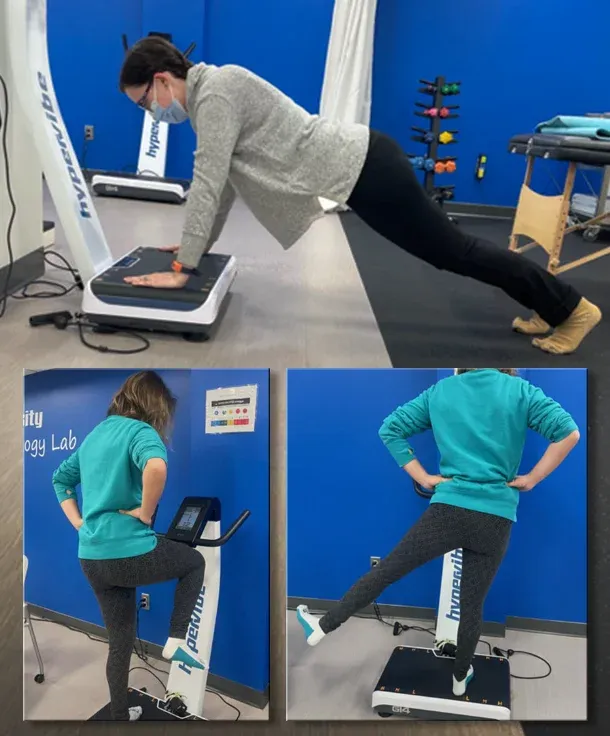
- Exercises on the plate, such as squats, lunges, and calf raises, rather than just standing still.
Most manufacturers recommend starting with 10 minutes or less a day and building up. Lifepro, for example, suggests 10 to 15 minutes a day and staying under 20. Longer sessions aren’t better: short sessions are what the trials used.
Is a Vibration Plate Safe?
In trials, side effects were rare, mild, and temporary. But trials screened out people with certain conditions, and plate manuals carry similar warnings. Check with your doctor first if you:
- Are pregnant
- Have a joint replacement, metal implants, a pacemaker, or recent surgery
- Have a history of blood clots, epilepsy, or retinal problems
- Have severe osteoporosis, recent fractures, or acute back pain
Stand with your knees slightly bent so the vibration doesn’t travel straight up to your head, and hold onto something sturdy if your balance isn’t steady.
Do Home Vibration Plates Match the Research?
Not always. The plates in clinical trials were often expensive machines (Galileo, Power Plate, or low-magnitude medical devices) running at 25 to 40 Hz. Many budget home plates are oscillating platforms that run at much lower frequencies. Lifepro lists its popular Waver at about 4 to 12 Hz, while its Rumblex 4D models go up to 40 Hz. Merach doesn’t publish frequencies for its plates.
A low-frequency plate can still be a fun, low-impact way to do squats and balance work, but if you want settings closer to the studies, look for a plate that publishes a range reaching 25 to 40 Hz.
Closest to research settings
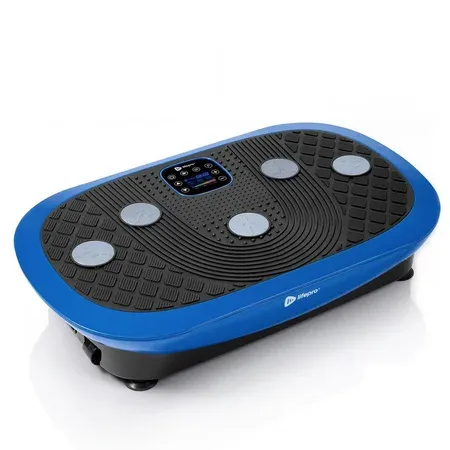
Lifepro Rumblex Plus 4D Vibration Plate
Three motors for oscillation, lateral, and pulsating motion, up to 40 Hz, a 500-pound rating, and a lifetime warranty.
The Rumblex Plus 4D is the plate we’d pick if you want to follow the research. Its three motors produce oscillation, side-to-side, and pulsating vertical motion, and Lifepro lists frequencies up to 40 Hz, which covers the 25 to 40 Hz range used in most positive trials. It has a flat, cushioned platform, a 500-pound rating, Bluetooth speakers, a remote, and a lifetime warranty.
Best-selling oscillation plate
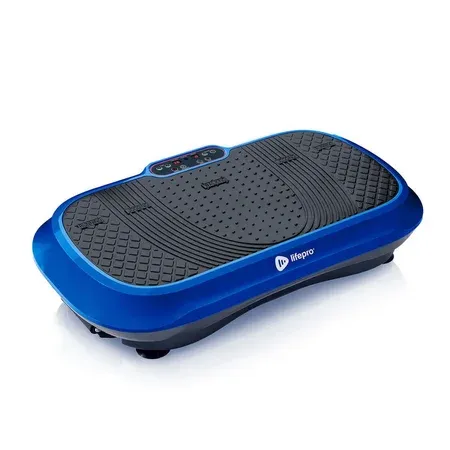
Lifepro Waver Vibration Plate
A compact oscillating plate with 99 speeds, a remote, resistance bands, a 330-pound rating, and a lifetime warranty.
The Waver is one of the most-reviewed plates on Amazon and a good choice for short daily sessions of squats and balance work. It runs at lower frequencies than most research plates, but it’s compact, comes with resistance bands, and has a lifetime warranty. Our Lifepro Waver review covers it and the rest of Lifepro’s lineup.
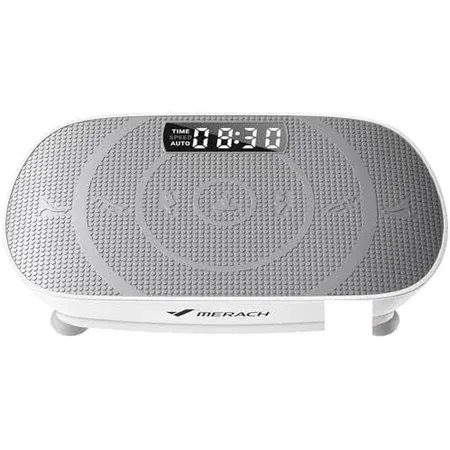
Best budget vibration plate
Merach CV30 Pro Vibration Plate
A compact curved plate with a 150W motor, 400-pound rating, Bluetooth speakers, and a remote.
The Merach CV30 Pro is one of the cheapest plates worth buying, with a 400-pound rating, though Merach doesn’t publish its frequency range and its warranty is one year. See our Merach vibration plate review and Merach vs. Lifepro comparison.
FAQ
Do vibration plates help you lose belly fat?
No. Reviews of 20+ trials found no meaningful effect on weight or fat mass from vibration training alone, and no study shows it targets belly fat. Spot reduction doesn’t work with any exercise.
Is 10 minutes on a vibration plate equal to an hour of exercise?
No. That claim isn’t supported by any study we found. Standing on a plate for 10 minutes burns roughly 15 extra calories, far less than an hour of walking.
What is a vibration plate good for?
The best evidence is for leg strength, balance, and mobility in older adults, especially those who can’t do regular strength training. It may also modestly lower blood pressure and help with back or knee pain as part of an exercise program.
Can I use a vibration plate every day?
Many manufacturers allow short daily sessions, and one large trial used 20 minutes a day, five days a week. Most trials used two or three sessions a week. Start with a few minutes and stay within your plate’s recommended limit.
More Fitness Guides
If you’re looking for low-impact ways to move more at home, see our best under-desk treadmills, stepper vs. walking pad, and foam roller vs. massage gun guides.