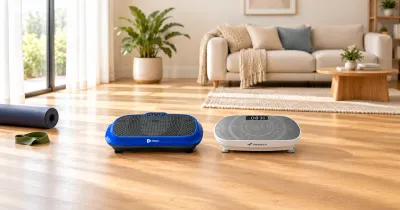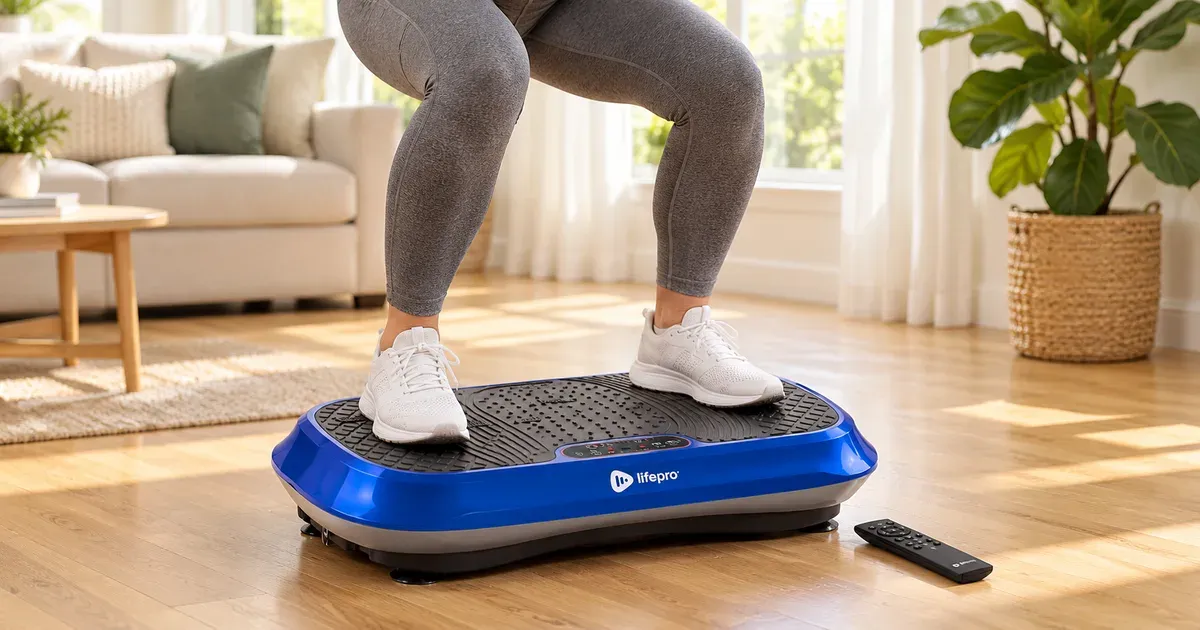
The Lifepro Waver is the vibration plate most people end up looking at. It costs about $200, has more than 30,000 ratings on Amazon, and comes with resistance bands and a remote, which makes it the default starting point for anyone curious about whole-body vibration at home.
It is a simple machine. The platform tilts side to side like a seesaw, a motion called oscillation, at up to about 12 vibrations per second. You stand, squat, or plank on it for 10 to 20 minutes. Lifepro’s more expensive plates add other kinds of motion and much higher speeds, so a big part of buying a Lifepro is deciding whether the Waver is enough.
Best-selling oscillation plate
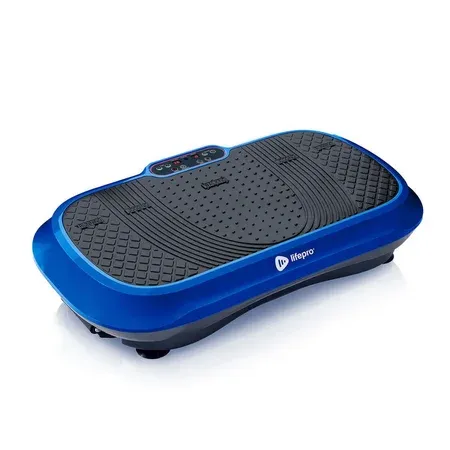
Lifepro Waver Vibration Plate
A compact oscillating vibration plate with 99 speeds, a remote, resistance bands, a 330-pound rating, and a lifetime warranty.
Lifepro Waver Review: Quick Verdict
The Waver is a sensible first vibration plate. It is affordable, rated for users up to 330 pounds, low enough to slide under a couch, and backed by a lifetime warranty, far longer than the one-year coverage on the walking pads we’ve reviewed. The included bands and remote mean you can start using it the day it arrives.
Its limits are about range, not quality. The Waver only oscillates, and it tops out at about 12 Hz. If you want vertical vibration, multiple motion patterns, or higher frequencies, the Rumblex 4D models cost twice as much and offer far more settings. If you mainly want to know whether you will use a vibration plate at all, the Waver is the better place to start.
Lifepro Waver specs at a glance
| Spec | Value | Note |
|---|---|---|
| Motion | Oscillation (side-to-side tilt) | One motion pattern |
| Motor | 200W | Single motor |
| Speed levels | 99 | Adjustable from the remote |
| Frequency | About 4 to 12 Hz | Up to roughly 720 vibrations per minute |
| Amplitude | 0 to 8 mm | How far the platform moves |
| Maximum user weight | 330 pounds | Per Lifepro |
| Dimensions | About 27.6 x 15.7 x 5.5 inches | Lifepro also lists 30.5 x 15.3 x 5.8 inches |
| In the box | Plate, remote, 2 handled bands, 4 loop bands | Plus a user guide |
| Recommended use | Up to 20 minutes a day | Lifepro suggests starting at 10 to 15 |
| Warranty | Lifetime | From Lifepro |
What the Lifepro Waver Specs Mean
Oscillation is the Waver’s only motion. The platform pivots on a center axis, so one foot rises while the other drops, many times a second. Your legs and core make small balancing adjustments to stay steady. Standing with your feet farther apart makes the movement larger. Lifepro recommends starting with a stable stance and a low speed, and widening your stance before you raise the speed.
Frequency is how many times per second the platform moves. The Waver covers about 4 to 12 Hz. That is gentle compared with Lifepro’s Rumblex 4D plates, which reach 40 Hz. Higher isn’t automatically better, but a wider range gives you more room to vary sessions.
Amplitude is how far the platform travels, up to 8 mm on the Waver. On an oscillating plate, the distance you feel also depends on where you stand: feet near the edges travel farther than feet near the center.
The 330-pound rating is generous for a plate this size. Lifepro’s smaller Waver Mini is rated for 260 pounds, and the flagship Rumblex Plus 4D goes up to 500.
One thing to check before ordering is space. Lifepro’s spec list puts the Waver at about 27.6 by 15.7 inches, while its product description says 30.5 by 15.3 inches. Either way it is about the size of a large doormat and 5.5 to 5.8 inches tall, low enough to store under many sofas and beds.
What the Research Says About Vibration Plates
Vibration plate marketing makes a long list of promises, including fat loss, lymphatic drainage, bone density, and circulation. The research supports some of these modestly and most of them weakly.
- Falls in older adults: a 2017 review in BMJ Open pooled four trials of adults 50 and older. People who did whole-body vibration training had about a third fewer falls. The authors rated the evidence moderate quality.
- Bone density: the same review found no overall effect on bone mineral density. A separate 2018 review of postmenopausal women in Medicine did find improvements in the lower spine, so the evidence is mixed.
- Fat loss: a 2019 meta-analysis in the Journal of Musculoskeletal and Neuronal Interactions found an average fat loss of about 0.76 kg (1.7 pounds) over 6 to 24 weeks. The authors called the change in body-fat percentage clinically insignificant.
- Blood flow: a 2015 meta-analysis in the Journal of Athletic Training found that whole-body vibration increased blood flow and muscle oxygenation in healthy adults.
- Lymphatic drainage: this is one of the most common claims in vibration plate ads, but there is little research to support it.
These studies looked at structured training programs, and the plates and settings varied, so the results don’t map neatly onto any one home plate. The realistic case for a Waver is as a low-impact way to add some balance and leg work to your day. It is not a substitute for walking, strength training, or a weight loss plan.
How to Use the Lifepro Waver
Most Waver workouts are short. Lifepro recommends starting with 10 to 15 minutes a day and staying under 20 minutes. The simplest routine is standing with your knees slightly bent and slowly raising the speed. From there, you can add squats, lunges, calf raises, or planks with your hands on the plate. The included bands let you add curls, rows, and presses while you stand.
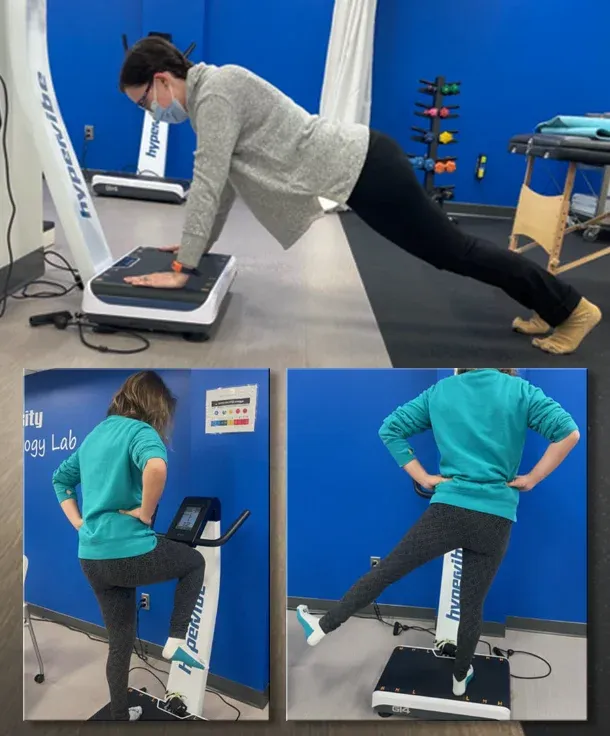
The Waver has no handles, so start slowly if your balance isn’t steady, and keep something sturdy within reach. Lifepro says the plate is not for children or pets. It also advises checking with your doctor first if you are pregnant, recovering from an injury or surgery, or managing a medical condition.
Lifepro Waver vs. Rumblex 4D and the Rest of the Lineup
Lifepro sells more than 20 vibration plates, but most differ in three ways: the type of motion, the frequency range, and the weight rating. These are the ones most people compare.
| Model | Motion | Frequency | Max user weight | Price at Lifepro |
|---|---|---|---|---|
| HexaPlate Lite | Oscillation | Not listed | 266 lb | $80 |
| TrimLite (with handles) | Oscillation | Not listed | 265 lb | $140 |
| Waver Mini | Oscillation | 4 to 12 Hz | 260 lb | $150 |
| Waver | Oscillation | 4 to 12 Hz | 330 lb | $200 |
| Waver Plus | Oscillation, 10 programs | 4 to 12 Hz | 330 lb | $250 |
| Turbo 3D | Oscillation + pulsation | 4 to 15 Hz | 330 lb | $250 |
| Rumblex 4D | Oscillation, lateral, pulsation | 4 to 40 Hz | 330 lb | $400 |
| Rumblex Plus 4D | Oscillation, lateral, pulsation | 4 to 40 Hz | 500 lb | $400 |
Prices are Lifepro’s list prices. The HexaPlate Lite carries a two-year warranty, while the Waver, Waver Mini, Waver Plus, Turbo 3D, and both Rumblex 4D models have lifetime coverage.
Choose the Waver if you want a simple plate for short daily sessions and don’t need more than one motion pattern. It has the best balance of price, weight rating, and warranty in the lineup.
Choose the Waver Mini or HexaPlate Lite if space or budget is tight, but note the lower weight ratings and, for the HexaPlate Lite, the shorter warranty. Choose the TrimLite if you want handles to hold. For a cheaper plate with a higher weight rating, see our Merach vibration plate review; the CV30 Pro costs about $90 and supports 400 pounds. Our Merach vs. Lifepro comparison puts the two brands side by side.
Choose a Rumblex 4D if you already know you like vibration training and want more variety. Its three motors produce oscillation, side-to-side lateral motion, and pulsation, alone or combined, across 60 speeds and up to 40 Hz, with Bluetooth speakers and a wrist remote. The Rumblex Plus 4D costs the same as the standard Rumblex 4D but has a flat, cushioned platform instead of a curved one and a 500-pound rating, which makes it the better choice of the two for most people.
Best lifepro upgrade
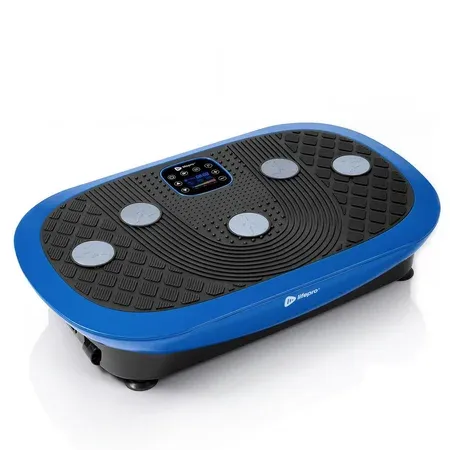
Lifepro Rumblex Plus 4D Vibration Plate
Three motors for oscillation, lateral, and pulsating motion, up to 40 Hz, 60 speeds, a 500-pound rating, and a lifetime warranty.
Who Should Buy the Lifepro Waver?
The Waver suits people who want a low-impact way to add movement at home, especially if long workouts or high-impact exercise aren’t realistic. It also works as a warm-up or balance tool alongside other exercise, and it takes up little space when you’re done.
It’s a weaker fit if you want measurable weight loss from the plate alone, since the research doesn’t support that. It’s also a weaker fit if you need something to hold for balance or want a wide range of vibration settings. In those cases, the TrimLite’s handles or the Rumblex 4D’s extra modes are better matches.
Final Verdict: Is the Lifepro Waver Worth It?
The Lifepro Waver is worth it as an inexpensive, well-supported way to try whole-body vibration. The 330-pound rating, included bands and remote, and lifetime warranty make it easy to recommend over cheaper no-name plates, and it costs half as much as Lifepro’s Rumblex 4D.
Go in with realistic expectations. The best evidence for vibration training is for balance and fall prevention in older adults, not fat loss or lymphatic drainage. If you use the Waver for a few short sessions a week alongside regular activity, it is a reasonable buy. If you expect it to replace exercise, no vibration plate will.