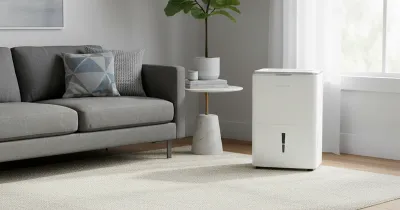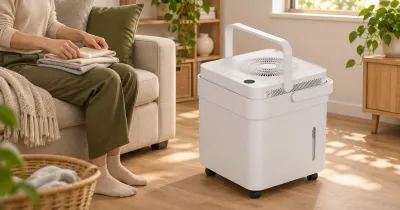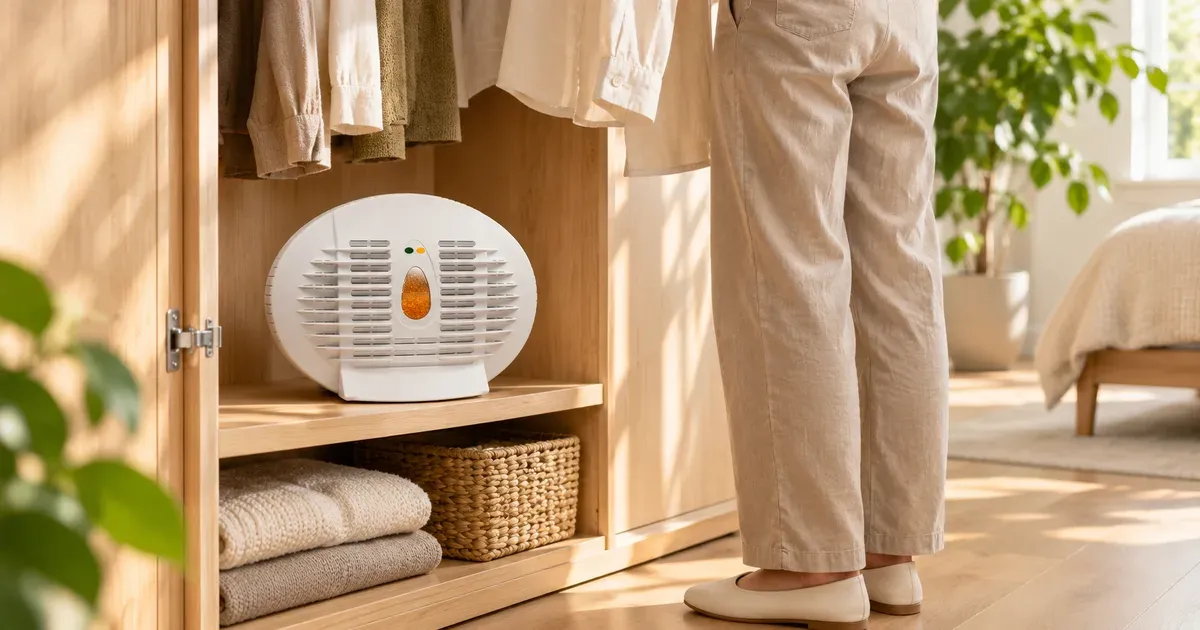
For a damp bedroom, the Midea Cube 20-pint is the smallest dehumidifier with real capacity: 20.16 pints a day on Energy Star’s list, for $152.98 on Amazon on November 23, 2026. For a quieter, smaller bedroom unit, the Waykar PD160B is rated at 33 dB but removes 10.16 pints a day, not the 34 on the box ($157.49). For a closet, don’t buy a compressor at all: the Eva-dry E-500 ($32.97) is a rechargeable silica-gel canister for up to 500 cubic feet.
“Small” covers two very different jobs. A bedroom or bathroom needs a compressor dehumidifier measured in pints per day. A closet, cabinet or safe needs a desiccant that’s measured by the space it covers in cubic feet. Mini “Peltier” (thermoelectric) units sit in between, and none we looked at had a DOE rating.
Small Dehumidifiers Compared
| Model | Capacity | Best for | Noise (maker) | Energy Star | Amazon, Nov 23, 2026 |
|---|---|---|---|---|---|
| Midea Cube 20 (MAD20S1QWT) | 20.16 DOE pints/day | Bedroom, laundry room | Not listed | Yes | $152.98 |
| Waykar PD160B | 10.16 DOE pints/day | Small bedroom | 33 dB | Yes | $157.49 |
| Black+Decker BDT08TW | 9.20 DOE pints/day | Bathroom, small room | Not listed | Yes | $146.99 |
| Eva-dry E-500 | Up to 500 cu ft | Closet, cabinet | Silent | n/a | $32.97 |
| Eva-dry E-333 | Up to 333 cu ft | Small closet, drawer, safe | Silent | n/a | $14.97 |
DOE pints are from Energy Star’s dehumidifier list (Version 6.0), tested at 65°F. Eva-dry rates its canisters in cubic feet: a 4 × 6 ft closet with an 8-ft ceiling is 192 cubic feet.
1. Midea Cube 20: Best for a Bedroom
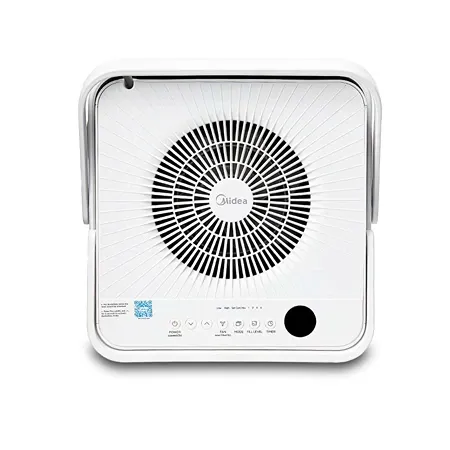
Best for a bedroom
Midea Cube 20 Pint (MAD20S1QWT)
Energy Star lists 20.16 DOE pints a day, twice the smaller units here. Collapsible cube body. $152.98.
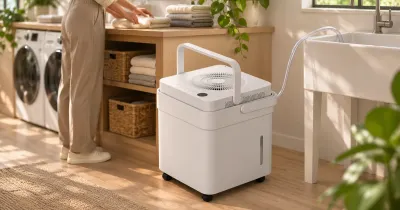
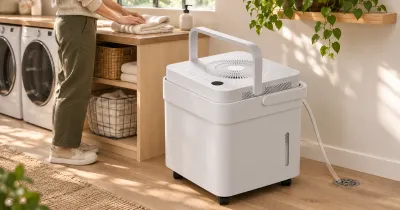
The Cube 20 removes 20.16 DOE pints a day, about twice the Waykar or Black+Decker. That’s what Energy Star recommends for a moderately damp room (50% to 75% humidity) under 2,000 sq ft. Its body collapses for storage. It was $152.98 on Amazon, below Midea’s $199. Midea doesn’t publish a noise rating.
2. Waykar PD160B: Quietest Small Compressor Unit
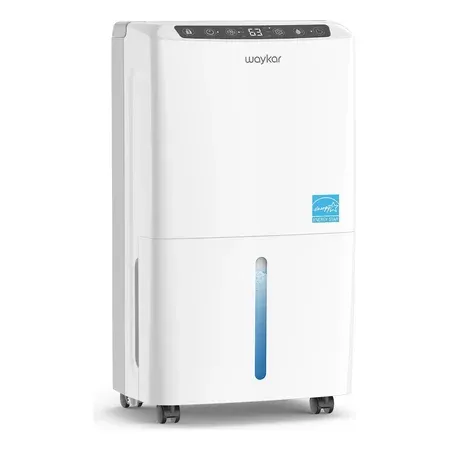
Quietest small compressor unit
Waykar PD160B
Waykar rates it at 33 dB. Sold as 34 pints, but Energy Star lists 10.16 DOE pints a day.
Waykar markets the PD160B as a 34-pint, 2,000 sq ft unit, but Energy Star lists it at 10.16 DOE pints a day. The 33 dB rating is the lowest we found on a compressor dehumidifier, which makes it a reasonable bedroom choice if the room is only mildly damp. It was $157.49 on Amazon.
3. Black+Decker BDT08TW: Best for a Bathroom
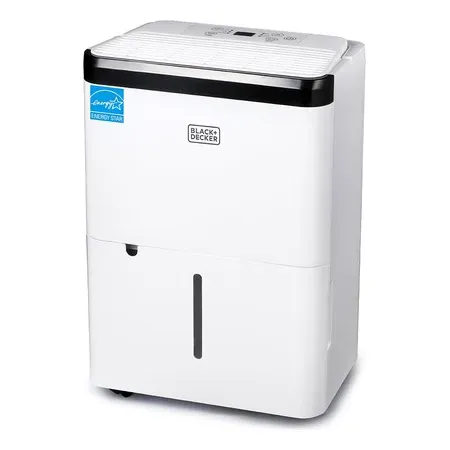
Best for a bathroom
Black+Decker 9-Pint (BDT08TW)
Energy Star lists 9.20 DOE pints a day. A compact compressor unit for a bathroom or small room.
Energy Star lists the BDT08TW at 9.20 DOE pints. It’s a compact compressor unit for a bathroom, laundry room or small bedroom. It was $146.99 on Amazon with limited stock. Black+Decker dehumidifiers are made under license, and we found no maker product page for noise or warranty.
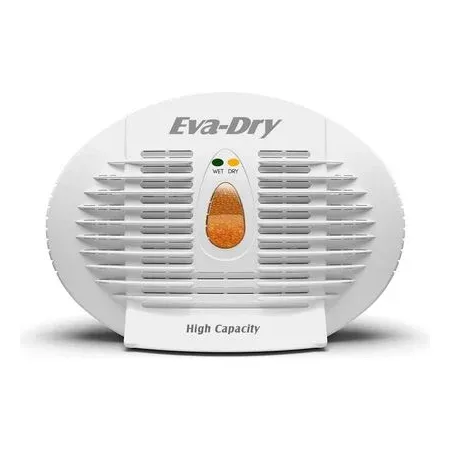
4. Eva-dry E-500: Best for a Closet
Best for a closet
Eva-dry E-500
Renewable silica gel for up to 500 cubic feet. No fan or cord while working; plug in to recharge.
The E-500 is a silica-gel canister: it absorbs moisture silently, and when it’s saturated you plug it in to dry it out and reuse it. Eva-dry rates it for up to 500 cubic feet, enough for a walk-in closet. Eva-dry’s single-unit and multipack pages give different water-capacity figures, so we don’t quote one. It was $32.97 on Amazon; a 2-pack was $69.95.
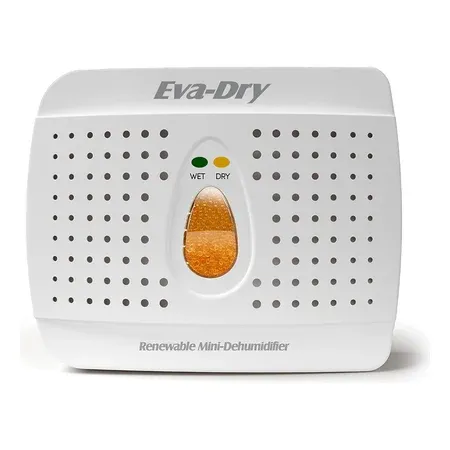
5. Eva-dry E-333: Best for a Drawer, Cabinet or Safe
Best for a Drawer, cabinet or safe
Eva-dry E-333
A smaller renewable silica-gel canister for up to 333 cubic feet. $14.97 on Amazon.
The E-333 is the smaller version, rated for up to 333 cubic feet: a reach-in closet, cabinet or gun safe. It was $14.97 on Amazon (Eva-dry lists $24.95). For safes, see the best gun safe dehumidifiers.
About Mini “Peltier” Dehumidifiers
Thermoelectric units like the Eva-dry EDV-1100 and Pro Breeze PB-02 are small, light and have no compressor. None we checked is on Energy Star’s list, and we couldn’t find a US maker spec page for the Pro Breeze range (Pro Breeze’s own site is UK-only and rates its models in liters per day on a different test). Without a DOE rating, there’s no reliable way to compare their capacity with the units above, so we don’t recommend them for a damp room.
How to Tell If a Small Room Needs One
- Measure first. EPA recommends keeping indoor humidity below 60% and ideally 30% to 50%. EPA puts hygrometers at about $10 to $50 (EPA).
- Fix the source. A bathroom without an exhaust fan, or a closet on a cold exterior wall, may need ventilation more than a dehumidifier.
- Health claims are thin. No systematic review shows dehumidifiers prevent mold allergy. In a year-long trial in 76 homes, a dehumidifier lowered humidity but didn’t cut dust mites more than the control groups (PubMed).
For bigger spaces, see the best dehumidifiers for basements. For more budget picks, see the best dehumidifiers under $200.
Sources
FAQ
What is the best small dehumidifier for a bedroom?
The Midea Cube 20, at 20.16 DOE pints a day for $152.98 (November 23, 2026). If the room is only slightly damp and noise matters most, the Waykar PD160B is rated at 33 dB.
What is the best dehumidifier for a closet?
A renewable silica-gel canister like the Eva-dry E-500 (up to 500 cubic feet) or E-333 (333 cubic feet). They’re silent and need no drain.
Do mini dehumidifiers work?
Silica-gel canisters work in small enclosed spaces. Compressor units rated around 9 to 10 DOE pints handle a bathroom or small bedroom. Mini thermoelectric units have no DOE rating, so their capacity is hard to judge.