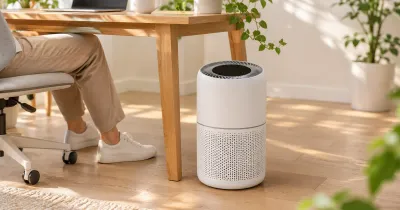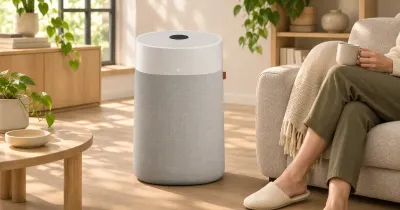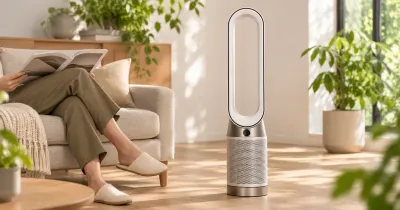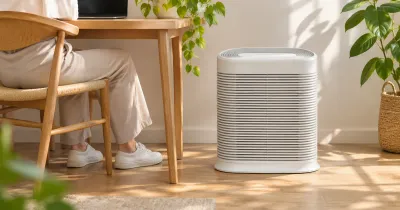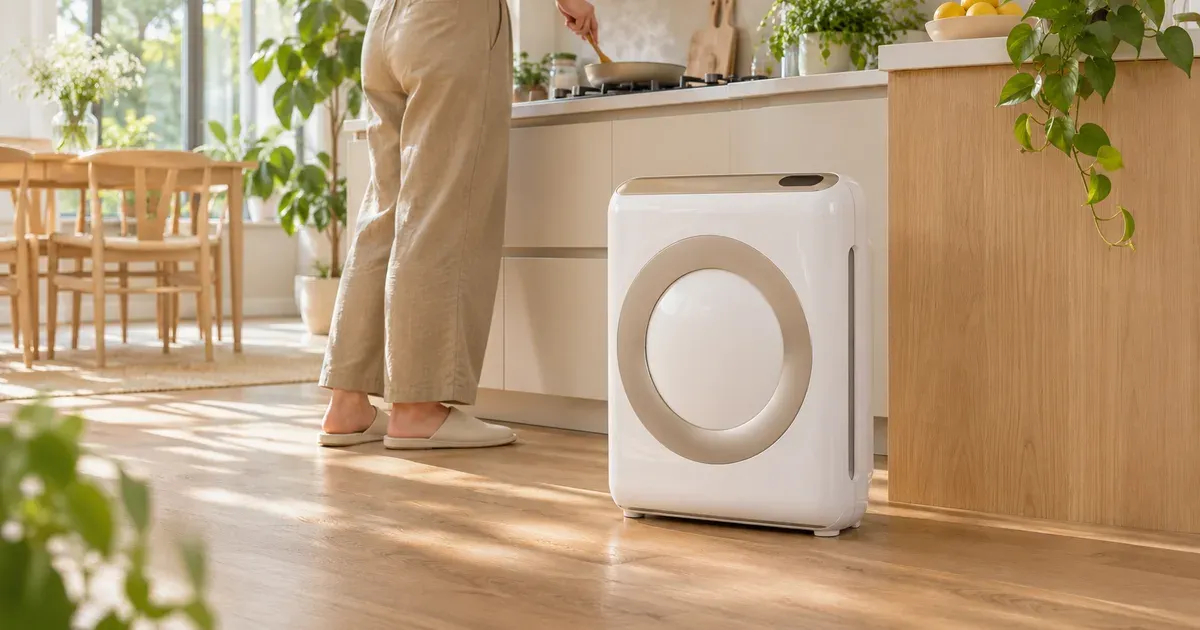
For cooking smells, pets and smoke odor you need activated carbon, and no rating tells you how much. The Winix 5520 ($128 on Amazon on November 23, 2026) and Coway Airmega AP-1512HH ($143.99) pair a HEPA filter with a separate carbon or deodorization filter you can replace on its own schedule, and both clean a 360–390 sq ft room of particles. For a bedroom, the Levoit Core 300-P ($80.73) takes a $39.99 Smoke filter with extra carbon. For a big kitchen-living space, the Levoit EverestAir-P ($499.99) has a dedicated carbon filter. Avoid “ozone” odor eliminators: EPA says ozone at safe levels does little to remove indoor contaminants.
Why CADR Doesn’t Cover Odors
AHAM’s CADR measures how fast a purifier removes smoke particles, dust and pollen. EPA’s guide to home air cleaners points out that there’s no common rating for gases, and odors are gases (volatile organic compounds from cooking oil, pet waste, cigarettes). HEPA filters don’t trap them; activated carbon adsorbs some of them until it’s saturated.
So for odors:
- Look for a separate carbon stage or an odor-specific filter. More carbon generally means longer odor control. Makers rarely publish carbon weight, so compare the odor filters they sell.
- Keep the CADR. Cooking also makes fine particles (smoke from frying), which CADR does cover.
- Replace carbon on time. Saturated carbon stops adsorbing. Coway rates its AP-1512HH deodorization filter at 6 months, half the life of its HEPA filter.
- Skip ozone. EPA says no federal agency approves ozone generators for occupied spaces, that ozone at concentrations within public-health limits does little to remove indoor contaminants, and that it reacts with indoor chemicals to form irritating by-products. A 2011 expert review of fan-driven air cleaners found particle filtration and sorption (carbon) among the most effective approaches, while many other technologies created unwanted by-products (PubMed).
For a kitchen, a range hood vented outdoors removes cooking fumes at the source; a purifier handles what escapes.
The Picks
| Odor stage | Smoke / dust / pollen CADR (CFM) | Room size at 4.8 ACH | Noise | Power | Replacement filter | CARB type | Amazon, Nov 23, 2026 | |
|---|---|---|---|---|---|---|---|---|
| Winix 5520 | AOC carbon filter | 253 / 252 / 247 (Winix) | 392 sq ft (AHAM) | from 23.5 dB | Not stated | Filter Q $49.99 sale / $79.99, 12 months | Electronic (PlasmaWave) | $128.00 |
| Coway Airmega AP-1512HH | Deodorization filter | 233 / 246 / 240 (Coway) | 361 sq ft (Coway) | 24–53 dB | 77 W | $59.79 set; carbon 6 months, HEPA 1 year | Electronic | $143.99 |
| Levoit Core 300-P | Carbon layer; Smoke or Toxin/Pet filter option | 143 / 153 / 167 (AHAM) | 222 sq ft | 24–54.5 dB | 56 W | $25.99; $35.99 Toxin/Pet; $39.99 Smoke | Mechanical | $80.73 |
| Blueair Blue Pure 211i Max | Carbon in standard filter; SmokeBlock option | 435 / 453 / >450 (AHAM) | 674 sq ft | 23–53 dB | 46 W | $69.99; $84.99 SmokeBlock | Electronic | $199.99 |
| Levoit EverestAir-P | Separate carbon filter | 354 / 373 / 431 (AHAM) | 549 sq ft | 24–56 dB | 70 W | $99.99 carbon | Mechanical | $499.99 |
| Rabbit Air A3 (Odor Remover) | Customized Odor Remover filter + charcoal | 257 / 262 / 315 (Rabbit Air) | 1,070 sq ft at 2 ACH (Rabbit Air) | 20.3–51.0 dB | 4.7–60.3 W | $115.95 kit, up to 2 years at 12 h/day | Electronic | $759.95 |
1. Winix 5520: Best Overall
The 5520 replaced the Winix 5500-2. It has a washable mesh pre-filter, a True HEPA filter and what Winix calls an AOC carbon filter for cooking, pet and smoke odors. Winix rates it at 253 smoke CFM, and AHAM sizes it for 392 sq ft. Filter Q (HEPA plus carbon) lasts 12 months and was $49.99 on Winix’s Black Friday sale, $79.99 normally. It also has PlasmaWave, Winix’s ion-generating stage, so CARB classifies it as Electronic. More: is the Winix 5500-2 still worth it.
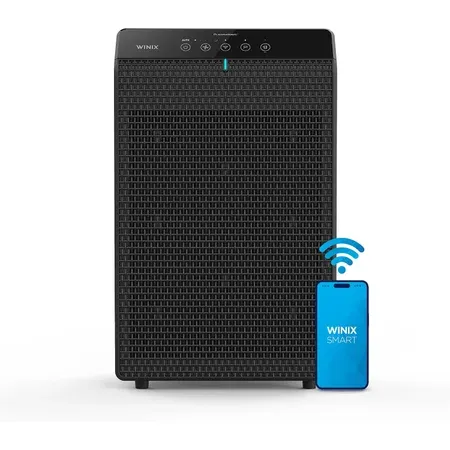
Best overall for odors
Winix 5520
AOC carbon + True HEPA, 253 smoke CFM (Winix), 392 sq ft (AHAM), from 23.5 dB. $128.00 on Nov 23, 2026.
2. Coway Airmega AP-1512HH: Best Separate Deodorization Filter
Coway’s AP-1512HH uses a washable pre-filter, a separate deodorization (carbon) filter rated for 6 months, and a HEPA filter rated for a year, so you can replace the carbon twice as often as the HEPA. Coway also sells an Intense Smoke version of its filter set ($64.99 at Coway). It has a bipolar ionizer and is CARB “Electronic”. The newer Mighty2 drops the ionizer and combines HEPA and carbon in one Max2 filter.
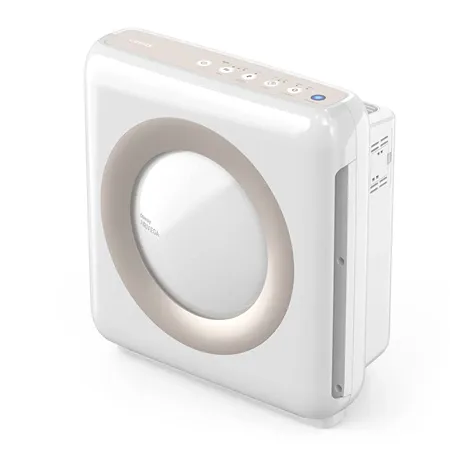
Best separate deodorization filter
Coway Airmega AP-1512HH
Pre-filter + deodorization filter (6 months) + HEPA (1 year), Coway CADR 233/246/240, 24–53 dB. $143.99 on Nov 23, 2026.
3. Levoit Core 300-P: Best for a Bedroom or Small Kitchen
The Core 300-P’s standard filter has a carbon layer, and Levoit sells two odor-focused swaps: Toxin Absorber/Pet Allergy ($35.99) and a 4-stage Smoke filter ($39.99). AHAM rates it at 143 smoke CFM for 222 sq ft. Levoit says to replace filters every 6 to 8 months.
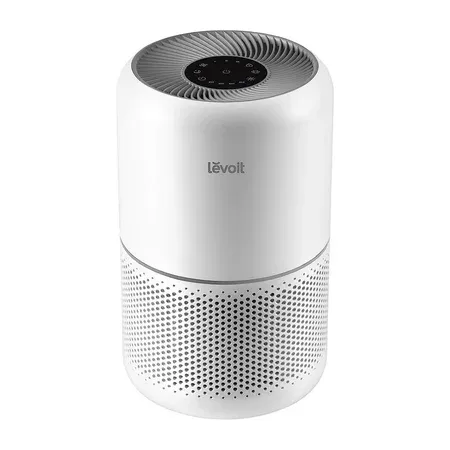
Best for a bedroom or small kitchen
Levoit Core 300-P
Carbon layer, $35.99 Toxin/Pet or $39.99 Smoke filter option, AHAM 143/153/167, 222 sq ft. $80.73 on Nov 23, 2026.
4. Blueair Blue Pure 211i Max: Best for Open Plans
For a combined kitchen and living room, the 211i Max’s particle CADR (435 smoke CFM, 674 sq ft) is the most per dollar here. Its standard Particle+Carbon filter is $69.99; the SmokeBlock filter ($84.99) adds carbon for smoke and cooking odors.
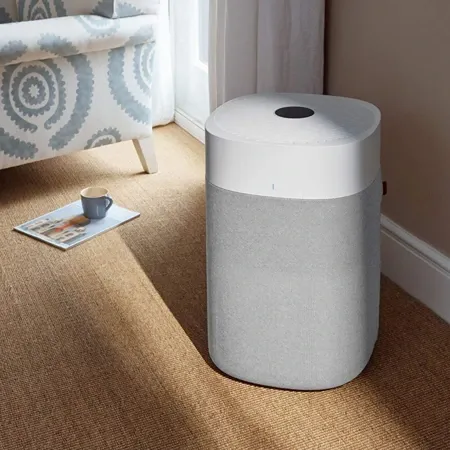
Best for open plans
Blueair Blue Pure 211i Max
AHAM CADR 435/453/>450, 674 sq ft, $84.99 SmokeBlock filter option, Energy Star Most Efficient. $199.99 on Nov 23, 2026.
5. Levoit EverestAir-P: Best Dedicated Carbon Filter
The EverestAir-P puts its carbon in a separate filter ($99.99) rather than a thin layer on the HEPA, and it’s AHAM-rated at 354 smoke CFM for 549 sq ft. A three-channel laser sensor reads PM1, PM2.5 and PM10, and the app can trigger it when air quality drops. CARB lists it as Mechanical. At $499.99, it’s for large rooms where cooking or pet odors are constant.
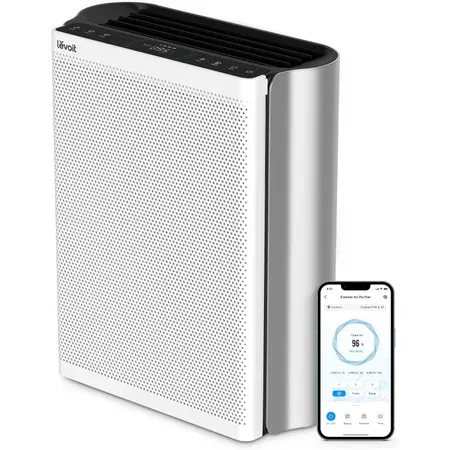
Best dedicated carbon filter
Levoit EverestAir-P
Separate $99.99 carbon filter, AHAM CADR 354/373/431, 549 sq ft, 24–56 dB, CARB Mechanical. $499.99 on Nov 23, 2026.
6. Rabbit Air A3 Odor Remover: Best Customizable Filter
Rabbit Air’s A3 has six stages, including a charcoal filter and a “customized” filter you choose for your problem; this listing ships with Odor Remover (others are Pet Allergy, Germ Defense and Toxin Absorber). Rabbit Air rates it at 257 smoke CFM and 20.3 dB on low, and says the filter kit ($115.95) lasts up to two years at 12 hours a day. It’s expensive at $759.95 and includes a negative-ion stage (CARB Electronic).
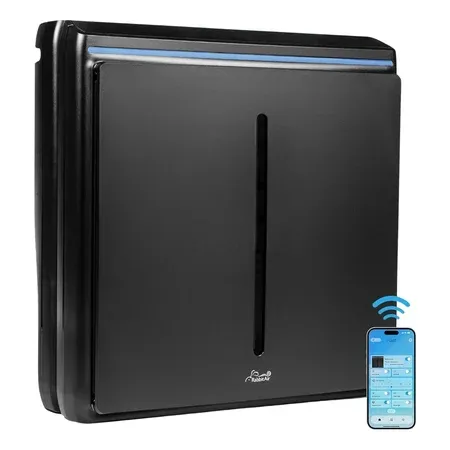
Best customizable filter
Rabbit Air A3 Odor Remover
6 stages incl. charcoal and Odor Remover filter, Rabbit Air CADR 257/262/315, 20.3–51.0 dB. $759.95 on Nov 23, 2026.
Getting Rid of Odors Faster
- Place it close to the source, out from the wall: near the kitchen, litter box or the room where someone smokes.
- Run it on high while cooking, then let Auto take over. Particle sensors react to cooking smoke, not to gases.
- Ventilate. Use a range hood vented outdoors and open windows when outdoor air is clean.
- Find the source. Lingering musty smells can mean mold, which an air purifier can’t fix; EPA says air cleaners don’t solve mold problems. See best air purifiers for mold and our dehumidifier vs. air purifier guide.
For pet hair and dander as well as smell, see best air purifiers for pets.
FAQ
Do air purifiers remove cooking smells?
Only with activated carbon, and only until the carbon is saturated. HEPA filters remove cooking smoke particles but not the gases that carry smell.
What is the best air purifier for odors?
The Winix 5520 is the best value: a separate AOC carbon filter plus True HEPA, sized by AHAM for 392 sq ft, at $128 on November 23, 2026. For a bigger space, the Levoit EverestAir-P has a dedicated $99.99 carbon filter.
Do ozone generators remove odors?
EPA says ozone at levels safe to breathe does little to remove indoor contaminants, and it can irritate the lungs and worsen asthma. No federal agency approves ozone generators for occupied spaces.
How often should I replace a carbon filter?
Follow the maker’s schedule: Coway rates the AP-1512HH deodorization filter at 6 months, and Winix rates Filter Q at 12 months. Heavy cooking or smoking uses carbon up faster.
Sources
- EPA: Guide to air cleaners in the home
- EPA: Ozone generators that are sold as air cleaners
- Atmos Environ (2011): review of fan-driven air cleaning technologies
- AHAM Verifide directory
- CARB certified air cleaning devices
- Winix: 5520
- Coway: Airmega Mighty AP-1512HH
- Levoit: Core 300-P
- Levoit: EverestAir-P
- Blueair: Blue Pure 211i Max
- Rabbit Air: A3