The short answer: the Panasonic has the inverter and more power, the Toshiba costs less and carries a shorter warranty. Both are 1.2 cu ft countertop microwaves with a humidity or steam sensor. The Panasonic NN-SN67KS delivers 1,200 W through an inverter, which gives steady low power for defrosting and gentle reheating. The Toshiba EM131A5C delivers 1,100 W (per its manual) the conventional way, cycling full power on and off at lower settings. One catch: the NN-SN67KS showed “Currently unavailable” on Amazon on November 19, 2026, and isn’t on Panasonic’s shop, so the Panasonic you can buy is the NN-SN67QS, the same cabinet with 1,250 W.
Prices checked November 19, 2026, on Amazon (sold by Amazon): Panasonic NN-SN67QS $199.95. Toshiba EM131A5C $119.99 in stainless (EM131A5C-SS) or $149.99 in black (EM131A5C-BS).
Panasonic vs. Toshiba at a Glance
| Panasonic NN-SN67KS (and NN-SN67QS) | Toshiba EM131A5C | |
|---|---|---|
| Capacity | 1.2 cu ft | 1.2 cu ft |
| Cooking power (output) | 1,200 W (NN-SN67QS: 1,250 W) | 1,100 W per manual (product page says 1,000 W) |
| Input power | 1,480 W | 1,550 W |
| Inverter | Yes | Not listed |
| Sensor | Genius steam sensor | Smart humidity sensor |
| Power levels | 10 | 10 |
| Turntable | Not published | 12.4 in |
| Exterior (W × D × H) | 20 11/16 × 15 13/16 × 12 1/4 in | 20.6 × 16 × 11.8 in (page also lists 20.5 × 17.2 × 12.8) |
| Cavity (W × D × H) | 13 15/16 × 14 3/8 × 9 15/16 in | Not published |
| Built-in option | Panasonic NN-TK621S trim kit | None listed |
| Warranty | 1 yr parts and labor; magnetron 5 yr parts | 1 yr; no separate magnetron term |
| Amazon price, Nov 19 | NN-SN67KS unavailable; NN-SN67QS $199.95 | $119.99 (SS), $149.99 (BS) |
Toshiba’s own US pages contradict themselves on wattage and size; the numbers above come from the EM131A5C owner’s manuals, which list 1,100 W output and 1,550 W input.
Inverter vs. Standard Power
This is the one real engineering difference. At power level 3, a standard microwave like the EM131A5C runs its magnetron at full power for part of each cycle and off for the rest. Panasonic’s inverter instead runs at a reduced, continuous output. In practice that helps most with:
- Defrosting, where full-power bursts start cooking the thin edges of a steak or chicken breast before the middle thaws.
- Softening and melting butter, chocolate or cheese without spatter or scorching.
- Reheating dense leftovers at medium power so the center heats while the edges stay moist.
For boiling water, popcorn and full-power reheating, both microwaves behave alike, and the 100 W gap means the Panasonic finishes a minute-long job a few seconds sooner.
Sensor, Controls and Size
Both use a sensor that reads the steam food releases to set reheat and cook times: Panasonic calls it Genius, Toshiba a smart humidity sensor. Both have 10 power levels.
The two cabinets are within an inch of each other, so either fits the same counter spot. The Panasonic can also go into a cabinet with its 27-inch NN-TK621S trim kit; Toshiba lists no trim kit for the EM131A5C.
Warranty
Panasonic covers the whole microwave for 1 year parts and labor and the magnetron, the part that makes the microwaves, for 5 years (parts; labor in year one). Toshiba’s US microwaves are warranted by Midea America Corp. for one year, and the US manuals list no separate magnetron term. A 10-year magnetron warranty you may see in Toshiba search results is Toshiba Malaysia’s and doesn’t apply to US units.
Which Should You Buy?
- Buy the Panasonic NN-SN67QS if you defrost meat often, cook at low power, or want the longer magnetron coverage. It’s the current version of the NN-SN67KS.
- Buy the Toshiba EM131A5C if you mostly reheat and pop popcorn at full power and want to spend about $80 less.
- Want a Toshiba with an inverter? The 1.6 cu ft ML-EM45PIT has one at 1,250 W.
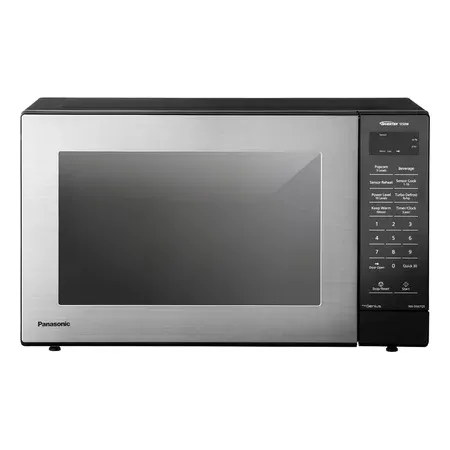
Best for defrosting
Panasonic NN-SN67QS
1.2 cu ft, 1,250 W inverter microwave with Genius sensor cooking; the current version of the NN-SN67KS.
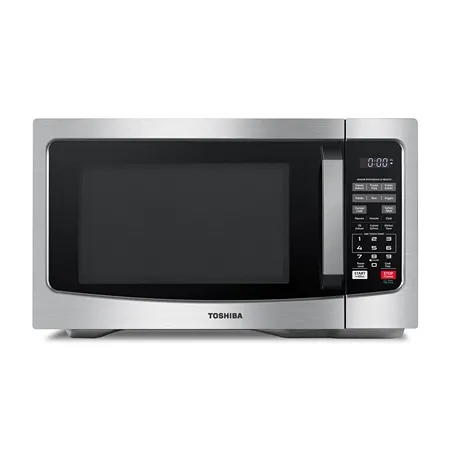
Best value
Toshiba EM131A5C-SS
1.2 cu ft, 1,100 W microwave with a smart humidity sensor, 10 power levels and a 12.4-inch turntable.
More options at both prices are in the best microwaves under $200 and the best inverter microwaves.
Panasonic NN-SN67KS vs. Toshiba EM131A5C FAQ
Is the Panasonic NN-SN67KS better than the Toshiba EM131A5C?
It has an inverter, 100 W more cooking power and a 5-year magnetron warranty. The Toshiba has a humidity sensor too and costs less. For defrosting and low-power cooking, the Panasonic is the better microwave.
How many watts is the Toshiba EM131A5C?
Its owner’s manuals list 1,100 W of output and 1,550 W of input. Toshiba’s US product page says 1,000 W.
Does the Toshiba EM131A5C have an inverter?
Toshiba doesn’t list one. Its US inverter models, such as the ML-EM45PIT, ML4-EM22PAIT and ML-EM13PAITF, carry “IT” in the model number.
Is the NN-SN67KS discontinued?
It isn’t on Panasonic’s shop, and its Amazon listing was unavailable on November 19, 2026. The NN-SN67QS uses the same 1.2 cu ft cabinet with 1,250 W.
Which has the longer warranty?
Panasonic: 1 year on the microwave plus 5 years on the magnetron part. Toshiba’s US warranty is 1 year.