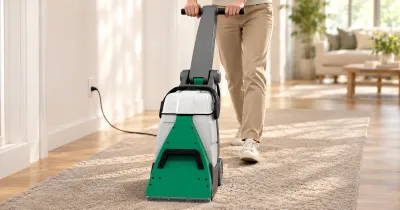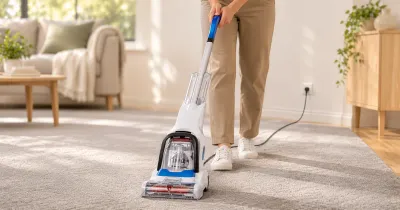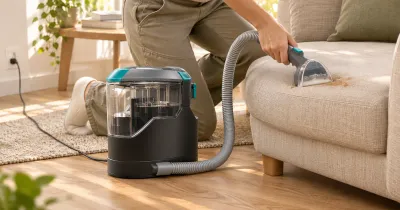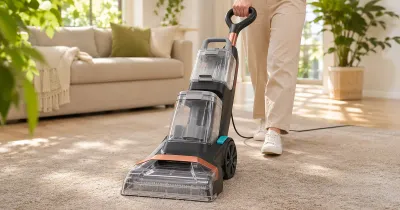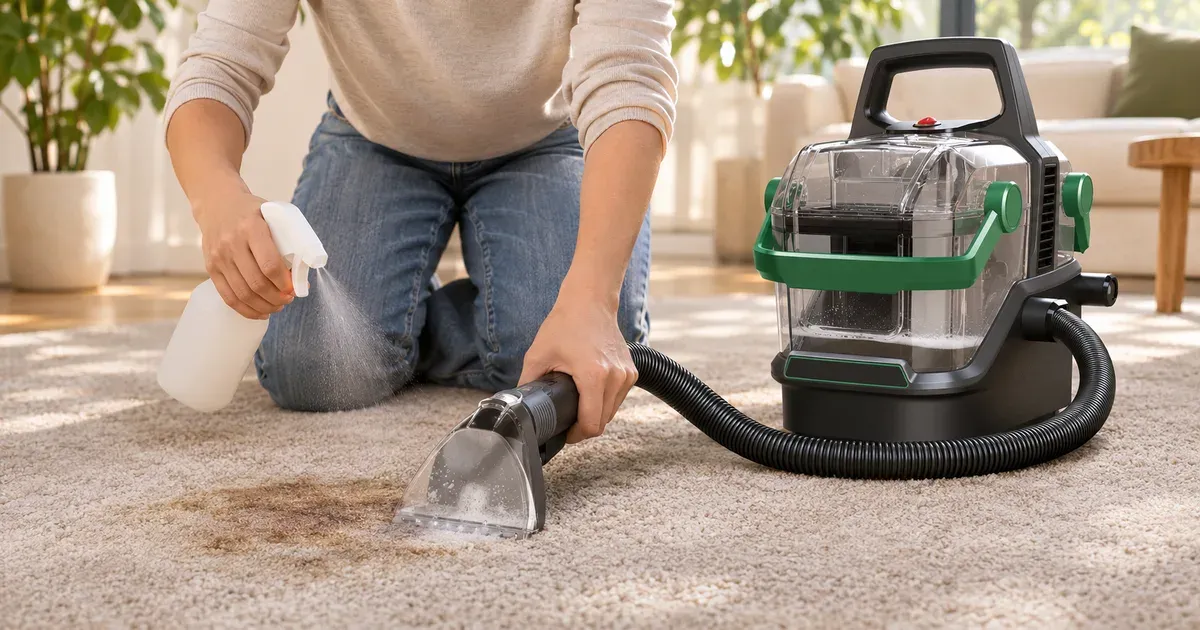
The short answer: vacuum up the dried residue, spray a Bissell pretreat on the stain and let it soak for 3 to 5 minutes, work it in by blotting with a damp white cloth, then extract it with the machine’s hose tool, repeating until nothing more comes out. Finish with a pass of clear water and weight a stack of white towels on the spot to stop it wicking back up. Old stains often take two or three rounds. Some, like old dye stains and aged urine, can’t be fully removed at home.
Step by Step
- Vacuum the dried residue. Bissell’s guide: “If the area has dried, remove the remaining semi-solids and residue with a sweeper or vacuum.” Scrape crusted bits first with a spoon, not a knife.
- Test the pretreat on a hidden spot. Bissell warns some dyes can be “damaged or discolored by cleaning solvents.”
- On Berber, run the machine over a hidden area first. If it doesn’t fuzz, continue.
- Pretreat. Spray Bissell’s pretreat (Tough Stain Pre-Cleaner or a Pet Stain Pretreat) evenly over the stain. Don’t overwet. Wait 3 to 5 minutes. On a Revolution Pet Pro, you can use the CleanShot button to spray pretreat from the foot and let it soak 5 minutes.
- Work it in. Bissell says to blot the area with a clean, damp, color-safe cloth. Shaw: always blot, never rub, and work from the outside edge in so the stain doesn’t spread.
- Extract. With the hose and a stain tool (Big Green: 6-inch Tough Stain Tool; ProHeat 2X: 3-inch Tough Stain Brush; Little Green: 4-inch tool), hold the tool about an inch above the stain and press the trigger, scrub with the bristles, then press the tool down and pull it slowly toward you with the trigger released.
- Repeat pretreat-and-extract until no more color transfers.
- Rinse with clear water. Refill the clean tank with plain warm water and go over the spot again. The IICRC, the cleaning industry’s standards body, says to rinse with clear water once no evidence of the stain remains; Shaw says detergent residue left behind turns sticky and resoils.
- Weight it dry. Lay several layers of white towels over the spot and weight them with something heavy that won’t transfer color, as Shaw suggests. This also pulls up anything still in the backing.
- Check it dry. If it reappears in a day or two, it’s wicking: see below.
For Leftover Color: Hydrogen Peroxide
The IICRC says residual color from many stains (wine, coffee, Kool-Aid, blood) “may be removed by applying 3% hydrogen peroxide and leaving it on the stain until the desired result is achieved,” which may take hours or several tries. Use a fresh bottle. Not on wool or other natural fibers without extensive testing, the IICRC warns, because it can bleach them. Rinse with clear water afterward.
When It Comes Back: Wicking
Old stains that soaked into the backing or pad often reappear as the carpet dries. The IICRC’s fix: let the carpet dry at least 48 hours, vacuum slowly from three directions, lightly mist with distilled water and blot, then cover with 6 to 10 layers of white paper towel, weight it, and leave it 6 to 8 hours, changing the towels until nothing transfers. More in why does carpet look dirtier after cleaning.
Stains You May Not Get Out
| Stain | Why | What to do |
|---|---|---|
| Red food dye (Kool-Aid, sports drinks) | The IICRC says red food dyes are nearly identical to carpet dyes | Fresh spills may come out; old ones usually need a professional |
| Aged pet urine | Can permanently change dyes and weaken fibers (IICRC) | Enzyme treatment for odor; color damage may stay. See how to get pet urine out of carpet |
| Old oxy-spotter yellowing | Unrinsed oxygen-bleach spotters can permanently bleach carpet (IICRC) | Only dyeing or patching fixes it |
| Bleach and acne cream (benzoyl peroxide) | Remove color from the fiber (Shaw) | Not a stain; color repair or patching |
| Coffee and tea on wool | Used to dye wool, the IICRC notes; 100% removal may not be possible | Professional |
For wine and coffee specifics, see can a carpet cleaner remove red wine and coffee stains.
What Not to Do
- Don’t rub or scrub hard. Shaw says it can fuzz the pile.
- Don’t use heat on protein stains like urine, blood or milk without testing; the Humane Society warns heat can set urine stains and odor.
- Don’t use bleach, household cleaners or vinegar in the machine. Bissell says vinegar can damage it.
- Don’t over-pretreat. More product means more residue to rinse out.
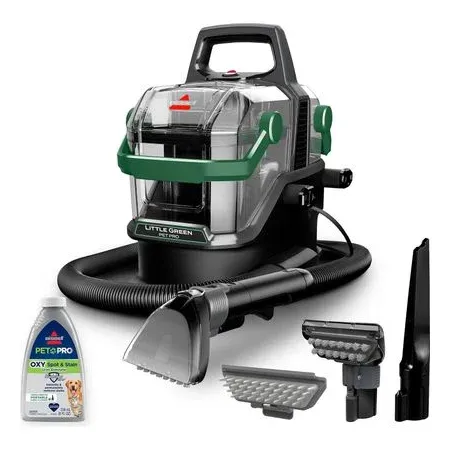
$139.99 on Amazon, Nov. 21, 2026
Bissell Little Green Pet Pro (3909)
A portable for working old spots with the hose tool, so you don't need the upright for one stain.
Old Carpet Stains FAQ
Can a Bissell remove old stains?
Often, with a pretreat, a few minutes of soak time and repeated extraction with the hose tool. Bissell warns that stains left too long “may cause it to set and become permanent.”
How long should pretreat sit before using a Bissell?
Bissell’s guides say 3 to 5 minutes for its Tough Stain Pre-Cleaner, and 5 minutes when using the CleanShot pretreater on the Revolution Pet Pro.
Why did the stain come back after I cleaned it?
Wicking: the stain is in the backing or pad and rises as the carpet dries. Mist with distilled water, blot, and weight towels on it.
Does hydrogen peroxide remove old carpet stains?
The IICRC suggests 3% hydrogen peroxide for leftover color on synthetic carpet, left on until it works. Not on wool or natural fibers without testing.
When should I call a professional for a stain?
Red dye stains, old urine damage, and stains on wool or natural fibers. The IICRC says these often need professional products and equipment.
Sources
- Bissell Big Green 86T3 user guide (PDF)
- Bissell Revolution Pet Pro 3588F user guide (PDF)
- Bissell Little Green 1400B user guide (PDF)
- IICRC consumer floor and furnishings care tip sheet (PDF)
- Shaw carpet care and maintenance guide
- Humane Society: How to remove pet stains and odors
- Bissell blog: 4 DIY floor cleaning mistakes