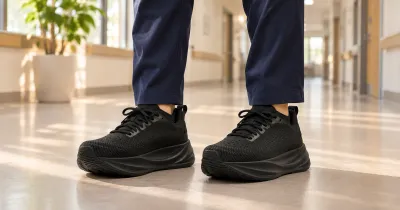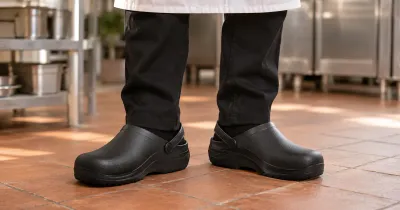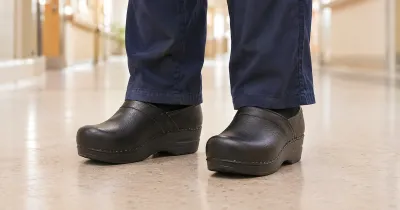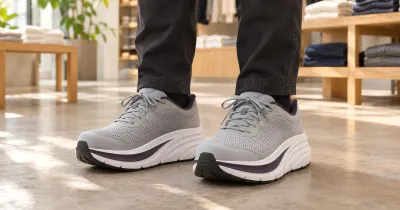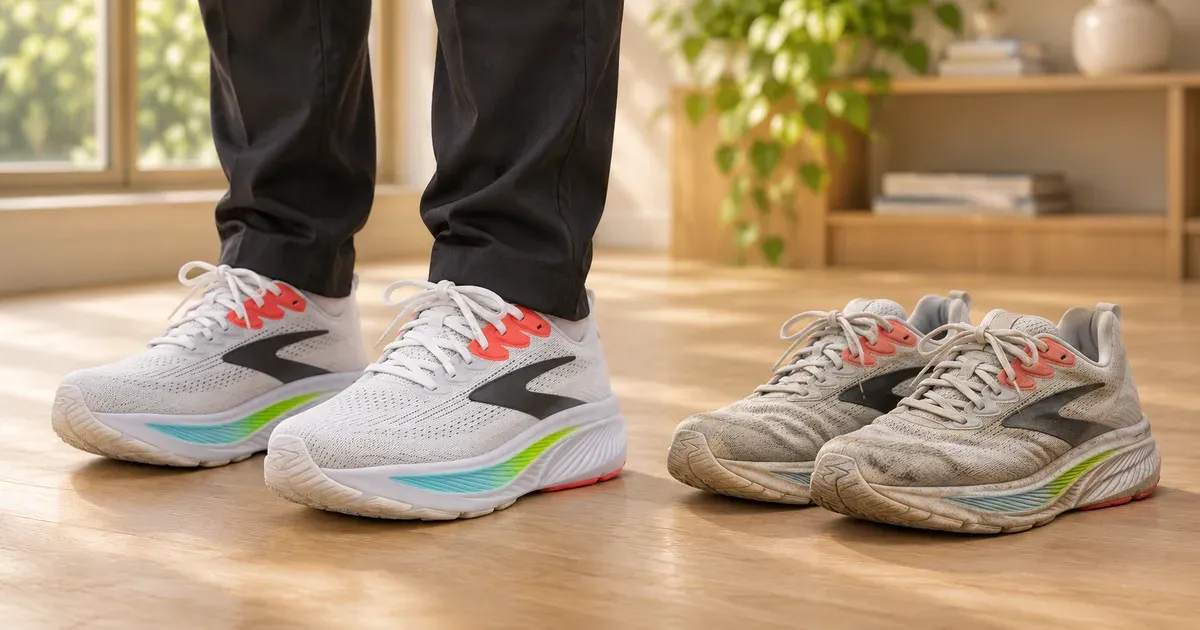
No study sets a replacement interval for shoes you stand in all day. The closest evidence is for slip-resistant work shoes: in a cohort of 475 restaurant workers, switching to a new pair was linked to a 55% lower slip rate, and pairs worn under 6 months worked moderately better than older ones. For cushioned sneakers, makers give mileage ranges for running (ASICS says 400–500 miles, Skechers 300–500), which are guidance rather than research. In practice, replace work shoes when the tread is worn smooth in any patch or the midsole looks crushed, and plan on roughly every 6 months if your job depends on slip resistance.
What the Research Shows
| Question | Best evidence | Finding |
|---|---|---|
| Is there a proven interval for everyday work shoes? | Searches of Europe PMC found no review | No. Any interval is guidance, not research. |
| Do new slip-resistant shoes cut slips? | Verma et al., 2014: cohort of 475 workers in 36 US limited-service restaurants | A new pair was linked to a 55% lower slip rate (RR 0.45, 95% CI 0.23–0.89). Shoes worn under 6 months did “moderately” better than older ones. |
| How fast does tread lose grip? | Hemler et al., 2022: two pairs each worn at work for up to 11 months | More months, more distance and a bigger worn patch all meant less traction. A worn patch of 800 mm² went with 16–38% less friction and 286–528% more fluid force under the shoe. |
| How far do workers walk in that time? | Same study | 3 months of wear averaged 203 km (about 126 miles) and 6 months 519 km (about 322 miles). |
| Do slip-resistant shoes work at all? | NHS trial of 4,553 staff; school food-service cluster trial | Yes: 37% fewer self-reported slips (IRR 0.63) and about two-thirds fewer slip-injury claims (OR 0.33). |
The restaurant cohort is observational and only 83 workers changed shoes, so it supports “new beats worn” more than it supports a precise 6-month rule. The tread study tracked friction, not injuries.
The two studies line up in one useful way: the workers in the tread study covered about 322 miles in 6 months, close to the low end of the 300–500 mile range makers quote for running shoes.
What Shoe Makers Say
- ASICS: “It’s generally recommended that runners replace their shoes every 400 to 500 miles,” and heavier runners will likely need to sooner.
- Skechers: the “300–500 mile range” is “a helpful checkpoint for many runners”, but “mileage is only a guide”. Skechers says old running shoes may still do for errands or short walks until they “feel uneven, slippery, or uncomfortable”.
- Clove claims its healthcare shoes last “2–3x longer than running shoes”. No study supports that.
These figures are written for running, where impact is higher than standing. No maker publishes a standing-hours figure.
Signs It’s Time to Replace Work Shoes
From the ASICS and Skechers guidance and the tread research:
- Smooth patches on the outsole. The tread study found the size of the worn region was the best single sign of lost grip. If any part of the tread pattern has worn flat, replace slip-resistant shoes now.
- A crushed or flat midsole. Foam that looks creased and compressed, or a shoe that leans when set on a flat floor, has lost cushioning.
- A stretched or torn upper. If the upper no longer holds your foot, the shoe is done.
- A worn-down sockliner. Skechers lists a lining or sockliner that “feels worn down” as a sign.
- New aches. ASICS lists pain as one of the clearest signs, though pain can have other causes.
Rotating Two Pairs
No study tests whether rotating two pairs of work shoes makes either last longer. The tread study’s participants did wear two pairs, but it measured wear rather than comparing rotation with a single pair.
Warranties Don’t Cover Wear
Shoe warranties cover defects, not worn-out foam or tread:
- Hoka: 1 year for “material or workmanship defects”, normal wear excluded, merchandise credit only.
- ASICS and Saucony: 1 year against manufacturing defects, normal wear excluded.
- Crocs: 90 days against manufacturing defects.
Brooks (90 days), Hoka (30 days, 60 for members), Timberland PRO (30-day Comfort Guarantee) and Shoes for Crews (60 days, $6.95 fee) take back shoes you’ve worn if they don’t suit you, but that’s a fit trial, not a durability guarantee.
When Your Employer Pays
OSHA has no rule requiring slip-resistant shoes; its foot-protection standard covers falling objects, punctures and electrical hazards. Its restaurant guidance does suggest employers consider a shoe policy and possibly help pay for shoes. In the restaurant cohort, 91% of workers wore slip-resistant shoes when the employer provided them, versus 53.5% when shoes were neither provided nor encouraged.
Ready for a New Pair?
- The best shoes for standing all day
- The best non-slip shoes for restaurant workers
- The best shoes for nurses
- Black Friday shoe deals for nurses and workers
- The best insoles for standing all day
Sources
- Verma et al., Ergonomics 2014 and J Occup Environ Hyg 2010
- Hemler et al., Effects of natural shoe wear on traction performance, 2022
- SSHeW trial, Occup Environ Med 2021; Bell et al., Scand J Work Environ Health 2019
- ASICS: how often should you change your running shoes
- Skechers: when to replace running shoes
- Hoka warranty, ASICS warranty, Saucony limited warranty, Crocs warranty
- OSHA 29 CFR 1910.136 and restaurant eTool
FAQ
How often should you replace shoes if you stand all day?
No study sets an interval. Replace them when the tread has worn smooth anywhere or the midsole looks crushed; for slip-resistant shoes, a restaurant cohort found pairs under 6 months old worked better.
How many miles do work shoes last?
Makers quote 300–500 miles for running shoes (ASICS 400–500, Skechers 300–500). Workers in a 2022 tread study walked about 322 miles in 6 months, and their shoes lost grip steadily over that time.
Do slip-resistant shoes wear out?
Yes. A 2022 study found traction fell as the worn patch on the outsole grew, with up to 38% less friction once it reached 800 mm².
Does a warranty cover worn-out work shoes?
No. Hoka, ASICS and Saucony warranties cover defects for a year and exclude normal wear.