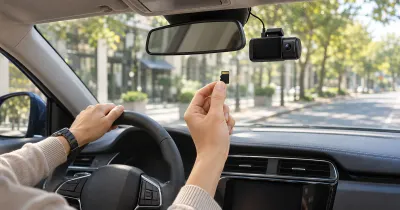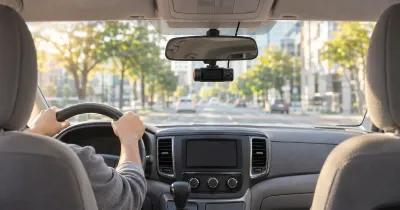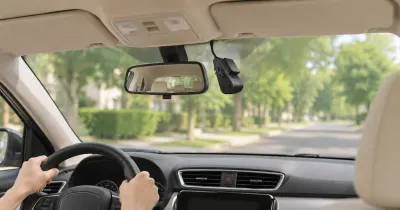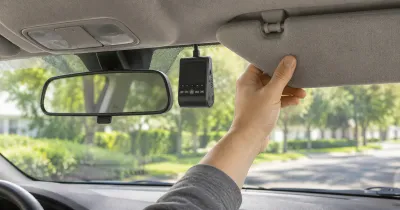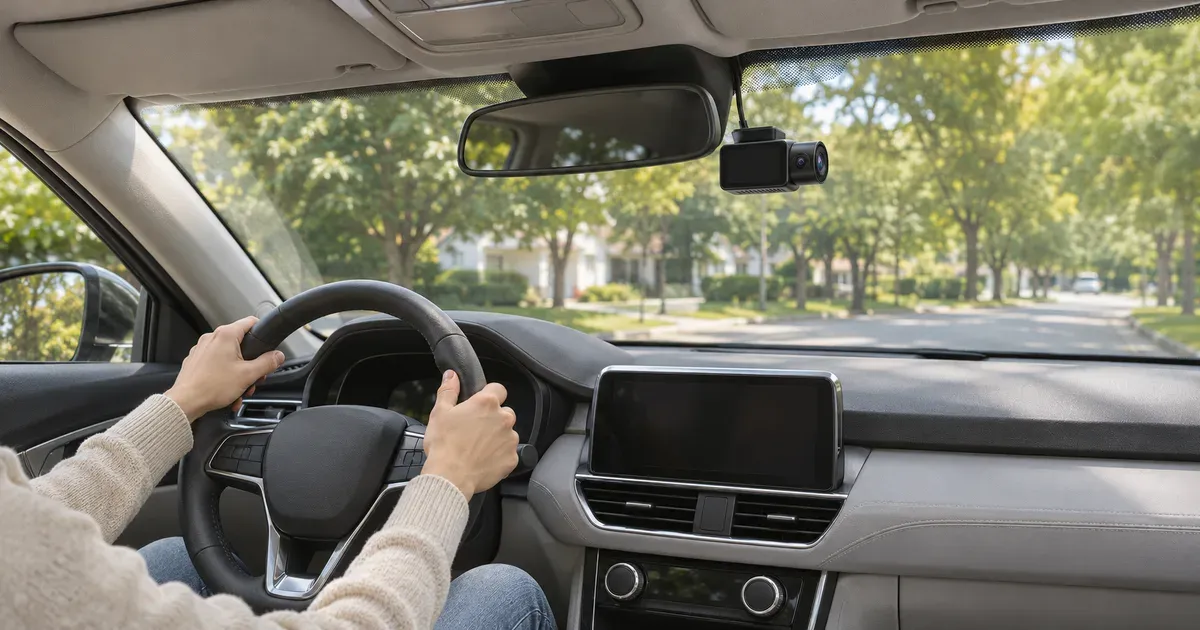
Dash cams are legal to own and use in all 50 states and Washington, D.C. No state bans them. Two kinds of state law decide how you can use one: the windshield statute, which limits where you can mount it, and the eavesdropping statute, which decides whether you can record audio of people in the car.
- Mounting: most states only ban objects that obstruct your view, so a small camera tucked behind the rearview mirror is the safe spot almost everywhere. A few states spell out exact zones:
- California gives three squares (5 in top center, 7 in lower passenger corner, 5 in lower driver corner).
- Virginia allows a dash cam that is “wholly or mostly concealed” behind the mirror.
- Minnesota and Arizona allow driver safety monitoring equipment mounted right behind, above or below the mirror.
- Audio: recording your own conversations is legal in most states with one party’s consent, and the driver counts as that party. Nine states require every party to a private conversation to consent: California, Florida, Illinois, Maryland, Massachusetts, Montana (hidden devices), New Hampshire, Pennsylvania and Washington. Delaware, Michigan, Missouri, Oregon and Hawaii have split or unsettled rules.
- Safest setup: in an all-party state, tell passengers you record audio, or turn it off.
This page summarizes statute text. It isn’t legal advice.
Dash Cam Laws: The Short Version
| Question | Answer |
|---|---|
| Is it legal to own a dash cam? | Yes, in every state and D.C. |
| Can I record video of the road? | Yes. There is no expectation of privacy on a public road, and the eavesdropping laws cover conversations, not images of traffic. |
| Can I mount it on the windshield? | Yes, if it doesn’t obstruct your view. A handful of states name exact zones or sizes (table below). |
| Can I record audio inside the car? | In one-party states, yes, if you’re in the conversation. In all-party states, everyone in a private conversation must consent. |
| What does federal law say? | 18 U.S.C. § 2511(2)(d) allows recording with one party’s consent. States can be stricter. |
| Commercial trucks? | 49 C.F.R. § 393.60(e) sets a federal mounting zone for safety devices. |
Windshield and Audio Laws by State
The windshield rule column groups each statute by what its text says:
- Obstruction: bans material or objects that obstruct the driver’s view.
- Strict: bans nontransparent material on the windshield except listed items.
- Zones: names allowed areas or sizes.
- Device allowed: expressly permits cameras or safety monitoring devices.
The audio column is the rule for recording an in-person conversation you take part in. Consent rules come from each state’s eavesdropping statute as summarized in the Reporters Committee for Freedom of the Press recording guide.
| State | Windshield rule | Windshield statute | Audio (in-person) | Consent statute |
|---|---|---|---|---|
| Alabama | Obstruction: no nontransparent material that obstructs the clear view | Ala. Code § 32-5-215(a) | One-party | Ala. Code § 13A-11-30 |
| Alaska | Obstruction: no nontransparent material that obstructs, obscures or impairs the view | 13 AAC 04.225(b) | One-party | Alaska Stat. § 42.20.310 |
| Arizona | Zones + device allowed: 7 in square in the lower corner farthest from the driver, 5 in square nearest the driver, and safety monitoring and driver feedback equipment behind, slightly above or below the mirror | A.R.S. § 28-959.01(A)(5), (12) | One-party | A.R.S. § 13-3005 |
| Arkansas | Zones: no obstructing material more than 4½ in above the bottom of the windshield | Ark. Code § 27-37-304(a)(1)(A) | One-party | Ark. Code § 5-60-120 |
| California | Zones: a “video event recorder” may sit in a 5 in square at top center, a 7 in square in the lower passenger corner, or a 5 in square in the lower driver corner outside the airbag zone; a posted notice that conversations may be recorded is required | Cal. Veh. Code § 26708(b)(13) | All-party (confidential conversations) | Cal. Penal Code § 632 |
| Colorado | Obstruction: the driver’s vision through required glass must be normal and unobstructed | C.R.S. § 42-4-201(4) | One-party | C.R.S. § 18-9-304 |
| Connecticut | Obstruction: no device attached or hung that interferes with an unobstructed view | Conn. Gen. Stat. § 14-99f(c) | One-party (all-party for phone calls, civil) | Conn. Gen. Stat. §§ 53a-187, -189 |
| Delaware | Strict: no sign, poster or nontransparent material on the windshield except required papers | 21 Del. C. § 4309(a) | Split: wiretap law one-party, privacy law all-party | 11 Del. C. §§ 2402(c)(4), 1335(a)(4) |
| District of Columbia | Not confirmed | — | One-party | D.C. Code § 23-542 |
| Florida | Strict: only required papers, a top sunscreen strip, toll devices and a GPS device used as part of safety monitoring equipment | Fla. Stat. § 316.2952(2) | All-party | Fla. Stat. § 934.03 |
| Georgia | Device allowed: a mount for a stand-alone electronic device, placed to minimize obstruction | O.C.G.A. § 40-8-73(a) | One-party | O.C.G.A. §§ 16-11-62, -66 |
| Hawaii | Zones: 7 in square in the lower corner farthest from the driver or 5 in square nearest the driver | Haw. Rev. Stat. § 291-21.5(e)(3) | One-party; all-party in a “private place” | Haw. Rev. Stat. §§ 803-42, 711-1111 |
| Idaho | Obstruction | Idaho Code § 49-943(1) | One-party | Idaho Code § 18-6702 |
| Illinois | Obstruction: no object between driver and windshield that materially obstructs the view; police can’t stop you for this alone | 625 ILCS 5/12-503(c-5) | All-party | 720 ILCS 5/14-2 |
| Indiana | Zones: up to a 4 in square in the lower corner farthest from the driver | Ind. Code § 9-19-19-3(b) | No in-person statute; federal one-party rule applies | 18 U.S.C. § 2511 |
| Iowa | Obstruction: windshield must permit clear vision | Iowa Code § 321.438(1) | One-party | Iowa Code § 808B.2 |
| Kansas | Obstruction: no material that substantially obstructs the view | K.S.A. § 8-1741(a) | One-party | K.S.A. § 21-6101 |
| Kentucky | Strict: nothing attached to or located on the windshield except listed items | KRS § 189.110(2) | One-party | KRS § 526.020 |
| Louisiana | Obstruction: no object placed on or affixed to the windshield that obstructs or reduces the view | La. R.S. 32:361.1(B) | One-party | La. R.S. 15:1303 |
| Maine | Obstruction: no object placed or hung that obstructs the view through the windshield | 29-A M.R.S. § 2082(2) | One-party | 15 M.R.S. §§ 709, 710 |
| Maryland | Zones: no object that interferes with the clear view; nontransparent material only near the top or in a 7 in square in a lower corner | Md. Code, Transp. § 21-1104(c), (d) | All-party | Md. Code, Cts. & Jud. Proc. § 10-402 |
| Massachusetts | Obstruction: no sign, poster or sticker that obstructs, impedes or distorts vision | M.G.L. c. 90, § 9D | All-party | M.G.L. c. 272, § 99 |
| Michigan | Strict: no nontransparent material on the windshield and no object that obstructs vision | MCL § 257.709(1)(a), (c) | Split: all-party for third parties; courts disagree on participants | MCL § 750.539c |
| Minnesota | Device allowed: driver feedback and safety monitoring equipment immediately behind, slightly above or below the mirror | Minn. Stat. § 169.71, subd. 1(a)(2)(iii) | One-party | Minn. Stat. § 626A.02 |
| Mississippi | Strict: no sign or poster except required or authorized papers | Miss. Code § 63-7-59(1) | One-party | Miss. Code § 41-29-531(e) |
| Missouri | Obstruction: labels and stickers allowed if they don’t interfere with the normal view | RSMo § 307.173.2 | Unsettled: little case law; all-party is the cautious reading | RSMo § 542.402 |
| Montana | Obstruction: no material that materially obstructs the view | MCA § 61-9-405(2)(a) | All-party knowledge for hidden devices; a warning makes recording legal | MCA § 45-8-213 |
| Nebraska | Obstruction: no object that significantly and materially obstructs the view | Neb. Rev. Stat. § 60-6,256 | One-party | Neb. Rev. Stat. § 86-290 |
| Nevada | Zones: material allowed in a 6 in square in the lower corner farthest from the driver | NRS § 484D.435(2) | One-party (in person) | NRS § 200.650 |
| New Hampshire | Obstruction: no nontransparent material on or next to the windshield that obstructs the view | RSA 265:95(III)(a) | All-party | RSA 570-A:2 |
| New Jersey | Strict: no non-transparent material on the windshield other than required items | N.J.S.A. 39:3-74 | One-party | N.J.S.A. 2A:156A-4 |
| New Mexico | Strict: no nontransparent material on or in the windshield | NMSA § 66-3-846(A) | No in-person statute; federal one-party rule applies | NMSA § 30-12-1 |
| New York | Obstruction: no object placed or hung that obstructs the view through the windshield | N.Y. Veh. & Traf. Law § 375(30) | One-party | N.Y. Penal Law §§ 250.00, 250.05 |
| North Carolina | Not confirmed (§ 20-127 covers wipers and tint) | — | One-party | N.C. Gen. Stat. § 15A-287 |
| North Dakota | Obstruction | N.D.C.C. § 39-21-39(1) | One-party | N.D.C.C. § 12.1-15-02 |
| Ohio | Device allowed: a camera or similar electronic device in the windshield if it doesn’t block sight lines to the road and signals or hide the VIN | Ohio Rev. Code § 4513.24(B)(2) | One-party | Ohio Rev. Code § 2933.52 |
| Oklahoma | Obstruction: no material on, or object suspended near, the windshield that materially obstructs the view | 47 O.S. § 12-404(C) | One-party | 13 O.S. § 176.4 |
| Oregon | Obstruction: no material that prevents or impairs seeing into or out of the vehicle | ORS § 815.220(2) | Split: all parties must be informed; struck for public places in 2023 | ORS § 165.540 |
| Pennsylvania | Obstruction: no nontransparent material that materially obstructs the view | 75 Pa.C.S. § 4524(a), (c) | All-party | 18 Pa.C.S. § 5704 |
| Rhode Island | Obstruction | R.I. Gen. Laws § 31-23-16(a) | One-party | R.I. Gen. Laws § 11-35-21 |
| South Carolina | Obstruction | S.C. Code § 56-5-5000 | One-party | S.C. Code § 17-30-30 |
| South Dakota | Obstruction | SDCL § 32-15-5 | One-party | SDCL § 23A-35A-20 |
| Tennessee | Not confirmed | — | One-party | Tenn. Code § 39-13-601 |
| Texas | Obstruction: an object attached to the windshield that obstructs or reduces the clear view is a misdemeanor | Tex. Transp. Code § 547.613(a)(1) | One-party | Tex. Penal Code § 16.02 |
| Utah | Zones: no device mounted that materially obstructs; nontransparent material only in the top 4 in or a small lower-left area | Utah Code § 41-6a-1635(2), (3) | One-party | Utah Code § 77-23a-4 |
| Vermont | Zones: items only in a 4 × 12 in lower-right space or a 2 × 2½ in upper-left space, plus a toll transponder behind the mirror | 23 V.S.A. § 1125 | No in-person statute; federal one-party rule applies | 18 U.S.C. § 2511 |
| Virginia | Device allowed: a dash cam with its wires and mount wholly or mostly concealed behind the rearview mirror; police can’t stop you under this section | Va. Code § 46.2-1054(B), (C) | One-party | Va. Code § 19.2-62 |
| Washington | Obstruction | RCW 46.37.410(2) | All-party | RCW 9.73.030 |
| West Virginia | Obstruction | W. Va. Code § 17C-15-36(a) | One-party | W. Va. Code § 62-1D-3 |
| Wisconsin | Strict: no nontransparent material on the windshield other than government stickers, and no object obstructing the view | Wis. Stat. § 346.88(3)(a), (b) | One-party | Wis. Stat. § 968.31 |
| Wyoming | Obstruction: no material that materially obstructs the view | Wyo. Stat. § 31-5-955(a) | One-party | Wyo. Stat. § 7-3-702 |
In the three “Not confirmed” places, mount the camera behind the mirror, out of your line of sight.
States That Name a Dash Cam Zone
Only a few windshield statutes mention cameras, recorders or safety monitoring devices by type. Several others set size limits for anything on the glass.
| State | What the law allows | Where |
|---|---|---|
| California | Video event recorder in a 5 in square at the top center, a 7 in square in the lower passenger corner, or a 5 in square in the lower driver corner outside the airbag zone. It needs a visible notice that passengers’ conversations may be recorded. | Veh. Code § 26708(b)(13) |
| Virginia | Any dashboard camera and its wires, if “wholly or mostly concealed behind the rear view mirror without any additional obstruction to the driver’s view” | Va. Code § 46.2-1054(C) |
| Minnesota | “Driver feedback and safety monitoring equipment” immediately behind, slightly above or slightly below the mirror | Minn. Stat. § 169.71 |
| Arizona | Safety monitoring and driver feedback equipment behind, slightly above or below the mirror, plus 7 in and 5 in lower-corner squares | A.R.S. § 28-959.01 |
| Ohio | A camera or other electronic device that doesn’t restrict sight lines to the road, signs and signals or hide the VIN | Ohio Rev. Code § 4513.24(B)(2) |
| Georgia | A windshield mount for a stand-alone electronic device, placed to minimize obstruction | O.C.G.A. § 40-8-73(a) |
| Hawaii | Signs, stickers or other materials in a 7 in square (far corner) or 5 in square (near corner) | Haw. Rev. Stat. § 291-21.5(e)(3) |
| Nevada | Material in a 6 in square in the lower corner farthest from the driver | NRS § 484D.435(2) |
| Indiana | Material no larger than 4 in square in the lower corner farthest from the driver | Ind. Code § 9-19-19-3(b) |
| Vermont | 4 × 12 in lower-right space, 2 × 2½ in upper-left space | 23 V.S.A. § 1125(b) |
California’s mounting rule: the 5 in square at the top center covers the usual spot behind the mirror, so a compact camera mounted there fits the statute. The statute’s definition of a “video event recorder” describes a device that loops video and saves clips when triggered by a crash or by the driver, which is how most dash cams work. Where a camera can’t sit inside a 5 in square, the lower passenger corner allows 7 in.
Can a Dash Cam Record Audio Legally?
Yes, in most of the country, if you’re part of the conversation. Federal law, 18 U.S.C. § 2511(2)(d), makes recording legal when “such person is a party to the communication” or one party has consented. Most states follow that one-party rule, so a driver can record their own conversations with passengers.
The all-party states are the exception. In these states every party to a private conversation has to consent:
- California
- Florida
- Illinois
- Maryland
- Massachusetts
- Montana (for hidden recording devices)
- New Hampshire
- Pennsylvania
- Washington
Several of these laws apply only where people have a reasonable expectation of privacy, so treat conversations inside your car as private.
How consent works in practice:
- Notice: in Washington, consent can be obtained by announcing the recording.
- Awareness: Massachusetts’ law applies only to secret recordings.
- California and rideshare: California’s windshield statute requires a posted notice that passengers’ conversations may be recorded.
Rideshare drivers register their camera in the Uber and Lyft driver apps, which tells riders they may be recorded. The app and dash cam rules are in the best dash cams for Uber and Lyft drivers.
Video of the road is a different question. The eavesdropping laws cover conversations, not images. Recording traffic, plates and other drivers on a public road doesn’t need consent in any state.
Where to Mount a Dash Cam on the Windshield
The spot that satisfies nearly every state’s statute is also where camera makers tell you to put it: high on the glass, tucked behind the rearview mirror.
- Out of your line of sight. Garmin’s X310 manual says: “Do not mount the camera in a location that interferes with the driver’s view of the road.”
- Inside the wiper sweep. Garmin also tells owners to verify that the glass in front of the lens is cleared by the wipers. The commercial-vehicle rule below uses the wiper-swept area as its reference too.
- Clear of tint and the dotted frit band. Garmin says to avoid mounting behind a tinted area of the windshield.
- Outside the airbag zone. California’s lower-driver-corner square must be outside an airbag deployment zone, and the side curtain airbags run along the A-pillars where people route power cables.
- Away from the car’s own camera housing. Many cars have lane-keeping and emergency-braking cameras behind the mirror; keep the dash cam from blocking them.
Adhesive mounts are hard to remove. Garmin warns that its adhesive mount “is difficult to remove after it is installed,” so test the position with the live view before pressing it on.
Commercial Trucks: The Federal Rule
For commercial motor vehicles, 49 C.F.R. § 393.60(e)(1)(ii) lets “vehicle safety technologies” (which include cameras) mount on the inside of the windshield:
- not more than 8.5 in below the upper edge of the area swept by the wipers, or
- not more than 7 in above the lower edge of that area,
- and outside the driver’s sight lines to the road and to highway signs and signals.
California’s and Ohio’s windshield statutes both cross-reference this federal rule for commercial vehicles. Truck camera picks are in the best dash cams for trucks.
Can You Use a Dash Cam in a Rental Car?
Yes. The state laws above apply to whoever is driving, so a rental is treated like your own car for mounting and audio.
Three practical points:
- Use a removable mount and plug-in power. Suction or a mount you can take off leaves nothing behind, and a 12V or USB plug avoids touching the car’s wiring. A hardwire kit taps the fuse box, which isn’t something to do to a car you don’t own.
- You’re liable for damage. Thrifty’s general policies make the renter and additional drivers “absolutely liable for any loss or damage to the rental vehicle,” so adhesive residue or a scratched trim panel is on you.
- Some rentals already record. Thrifty’s policies say its rental EVs “may be equipped with a Dash Cam” whose recordings “may be used by Hertz,” and that you’re responsible for deleting personal data at return.
Dash Cam Laws FAQ
Are dash cams legal in all 50 states?
Yes. Every state and Washington, D.C. allows dash cams. The restrictions are about where you mount the camera on the windshield and whether you record audio of other people’s private conversations.
Is it legal to mount a dash cam on the windshield in California?
Yes, in one of three places set by Vehicle Code § 26708(b)(13):
- a 5 in square at the top center of the windshield
- a 7 in square in the lower passenger-side corner
- a 5 in square in the lower driver-side corner, outside the airbag zone
The vehicle must also show a notice that passengers’ conversations may be recorded.
Can a dash cam record audio legally?
Yes, in one-party states, as long as you’re part of the conversation. In California, Florida, Illinois, Maryland, Massachusetts, Montana, New Hampshire, Pennsylvania and Washington, every party to a private conversation must consent, so tell passengers or turn audio off.
Where should I mount a dash cam?
High on the windshield behind the rearview mirror, inside the wiper sweep, clear of tint and out of your line of sight. That spot fits the zone rules in California, Virginia and Minnesota and the obstruction rules everywhere else.
Can I get pulled over for a dash cam?
In states with an obstruction rule, a camera that blocks your view can be cited. Virginia bars stops under its windshield-object statute altogether. Illinois bars stops based solely on an object between the driver and the windshield.
Are dash cams legal for commercial trucks?
Yes. Under 49 C.F.R. § 393.60(e), a camera on a commercial vehicle’s windshield must sit within 8.5 in of the top or 7 in of the bottom of the wiper-swept area, outside the driver’s sight lines.
Sources
- California Vehicle Code § 26708
- Virginia Code § 46.2-1054, Minnesota Statutes § 169.71, Arizona Revised Statutes § 28-959.01, Ohio Revised Code § 4513.24
- Florida Statutes § 316.2952, Illinois 625 ILCS 5/12-503, Maryland Transportation § 21-1104, Michigan MCL 257.709, Vermont 23 V.S.A. § 1125, Wisconsin § 346.88, Delaware Title 21, Chapter 43, Nevada NRS 484D
- Other state windshield statutes as cited in the table, read on each legislature’s site or the state code text
- 49 C.F.R. § 393.60, eCFR
- 18 U.S.C. § 2511
- Reporters Committee for Freedom of the Press, Reporter’s Recording Guide (state consent rules and statute citations)
- Garmin Dash Cam X310 owner’s manual (mounting considerations)
- Thrifty general policies