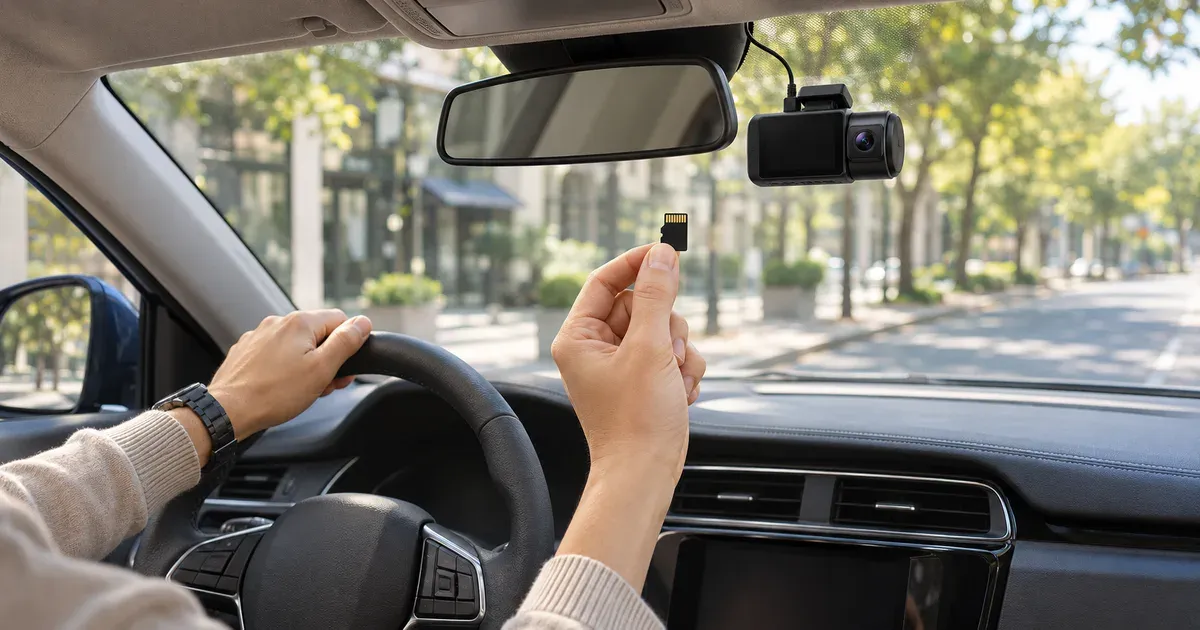
Yes. Dash cam footage is admissible in US courts like any other video, as long as it’s authenticated and relevant to the case. Under Federal Rule of Evidence 901, the person offering it only has to produce “evidence sufficient to support a finding that the item is what the proponent claims it is.” Usually that means the driver testifies that the clip shows what happened.
Two limits matter:
- A judge can exclude it under Rule 403 if it would mislead or unfairly prejudice the jury, which is a risk with edited clips.
- Illegally recorded audio is barred as evidence under 18 U.S.C. § 2515.
State courts apply their own evidence codes, and this isn’t legal advice.
What Makes Dash Cam Footage Admissible
| Requirement | What the rule says | What it means for a dash cam clip |
|---|---|---|
| Relevance (FRE 401) | Evidence is relevant if it makes a fact “more or less probable than it would be without the evidence” and the fact matters to the case | Footage of the crash, the light or the other car’s lane change easily qualifies |
| Authentication (FRE 901(a)) | “Evidence sufficient to support a finding that the item is what the proponent claims it is” | The driver, or anyone who saw the event, testifies that the video fairly shows it. Rule 901(b)(1) lists “testimony of a witness with knowledge” as one way to do this |
| Distinctive characteristics (FRE 901(b)(4)) | Appearance, contents and “other distinctive characteristics” taken with the circumstances | Timestamps, GPS speed and location overlays, and the car’s own hood in frame help tie the clip to your car and the date |
| Original or duplicate (FRE 1001(d), 1003) | For electronically stored information, any printout “or other output readable by sight” that accurately reflects the data counts as an original. A duplicate is admissible unless authenticity is genuinely questioned | An accurate copy of the file is fine, but keep the original card file in case authenticity is challenged |
| No unfair prejudice (FRE 403) | Relevant evidence can be excluded if “substantially outweighed by a danger of” unfair prejudice, confusing the issues or misleading the jury | A cropped, slowed or spliced clip invites this objection; the full, unedited file doesn’t |
| Lawfully recorded audio (18 U.S.C. § 2515) | Illegally intercepted oral communications, and anything derived from them, “may [not] be received in evidence” in any federal or state proceeding | Audio of passengers recorded without consent in an all-party state can be excluded |
State courts apply their own rules of evidence, such as the Tennessee Rules of Evidence, so check the rule numbers in your state. Recording-consent rules by state are in dash cam laws by state.
How to Preserve Dash Cam Footage
Most dash cams record in a loop and overwrite the oldest files. Event clips are locked when the G-sensor detects an impact or when you press the save button. To keep footage usable as evidence:
- Lock or save the clip right away, before the loop overwrites it, and stop recording if the card is nearly full.
- Copy the original file without editing it. Keep the file name, timestamp and any GPS data intact. Export a separate copy if you want to trim or zoom.
- Keep the memory card. If authenticity is ever disputed, the card and the camera’s native file are the strongest originals.
- Write down where the copies went: who you sent the file to, when and how. That record answers chain-of-custody questions later.
- Check the camera’s clock. A wrong date or time doesn’t make a clip inadmissible, but you’ll have to explain it. Set the clock (or use GPS time) before you need it.
Can Police Take Your Dash Cam Footage?
They can ask for it, they can get a warrant or subpoena for it, and they can only seize the camera without a warrant in narrow circumstances. The Fourth Amendment protects your camera and its card like other property.
| Situation | What police can do | Basis |
|---|---|---|
| They ask you to share a clip | It’s a request. You can share a copy voluntarily | Consent |
| They have a search warrant | Seize the camera or card within the warrant’s scope | Fourth Amendment |
| A subpoena in a criminal or civil case | You can be ordered to produce “electronically stored information, or tangible things” in your possession | Fed. R. Civ. P. 45(a)(1)(A)(iii) (federal civil cases) |
| No warrant, but probable cause the footage is evidence of a crime and an emergency | A temporary seizure to preserve evidence until a warrant is obtained | United States v. Place; Illinois v. McArthur, as summarized by the Justice Department |
| No warrant and no real emergency | Seizure can violate the Fourth Amendment | Hupp v. Cook (4th Cir. 2019) |
The Justice Department’s position. In a 2012 letter to the Baltimore Police Department, the Justice Department wrote that police policies should instruct officers that “except under limited circumstances, officers must not search or seize a camera or recording device without a warrant.” It said a warrantless seizure is permitted only where officers have probable cause that the device holds evidence of a crime and the circumstances demand it. Any such seizure must be a temporary restraint until a warrant is obtained. The letter also notes that seizing a camera implicates the First Amendment as well as the Fourth.
Hupp v. Cook (2019). A West Virginia trooper entered a home without a warrant and seized phones that had recorded an arrest. His practice, he testified, was to seize recording devices whenever he believed someone had captured evidence. The Fourth Circuit reversed the summary judgment the district court had granted him on the unlawful entry and seizure claims. It held that treating every possible loss of a video as an emergency “would convert exigency from an exception to the rule.”
If police take your camera or card, don’t physically resist. Ask for a property receipt and the case number, and keep your own copy of the footage if you made one.
Does Dash Cam Footage Help an Insurance Claim?
Footage doesn’t raise what an insurer pays. It settles who was at fault, and fault decides whose policy pays and how much. A clip showing the other driver ran the light or merged into you helps the claim go against their policy at full value instead of being split or denied. Your own policy limits and deductible still apply.
Discounts for simply having a camera are a separate question:
- Louisiana study: Louisiana’s Department of Insurance studied a proposed mandatory 5% dash cam discount in 2022. It found “a basis for actuarially justified” discounts, but recommended against mandating a specific one.
- Which insurers offer one: covered in the best dash cams for insurance.
Dash Cam Footage in Court FAQ
Can dash cam footage be used in court?
Yes. It’s admissible like any other video once it’s authenticated under Rule 901, usually by the driver testifying that it accurately shows what happened, and it’s relevant to the case. A judge can still exclude a misleading or unfairly edited clip under Rule 403.
Can dash cam footage be used against me?
Yes. Footage is evidence for whatever it shows, including your own speeding or a missed stop. It can be subpoenaed in a lawsuit or obtained with a warrant in a criminal case.
Do I have to give police my dash cam footage?
Not on request alone. Police need your consent, a warrant or a subpoena. A warrantless seizure is limited to cases with probable cause and an emergency, and then only until a warrant is obtained.
Is audio from my dash cam admissible?
Only if it was recorded legally. Under 18 U.S.C. § 2515, illegally intercepted conversations can’t be received in evidence. In all-party consent states, audio of passengers who didn’t consent is a risk.
Should I edit footage before sending it to an insurer or court?
Send an unedited copy and keep the original file. Trimmed or zoomed versions are fine as extras, but the full clip with its timestamp is what answers authenticity questions.
Sources
- Federal Rule of Evidence 901, Rule 401, Rule 403, Rule 1001 and Rule 1003
- 18 U.S.C. § 2515 and 18 U.S.C. § 2511
- Federal Rule of Civil Procedure 45
- U.S. Department of Justice, Civil Rights Division letter in Sharp v. Baltimore City Police Department, May 14, 2012
- Hupp v. Cook, No. 18-1845 (4th Cir. July 25, 2019)
- Louisiana Department of Insurance, HR 197 report on dashboard camera insurance incentives (Dec. 30, 2022)
- Tennessee Rules of Evidence