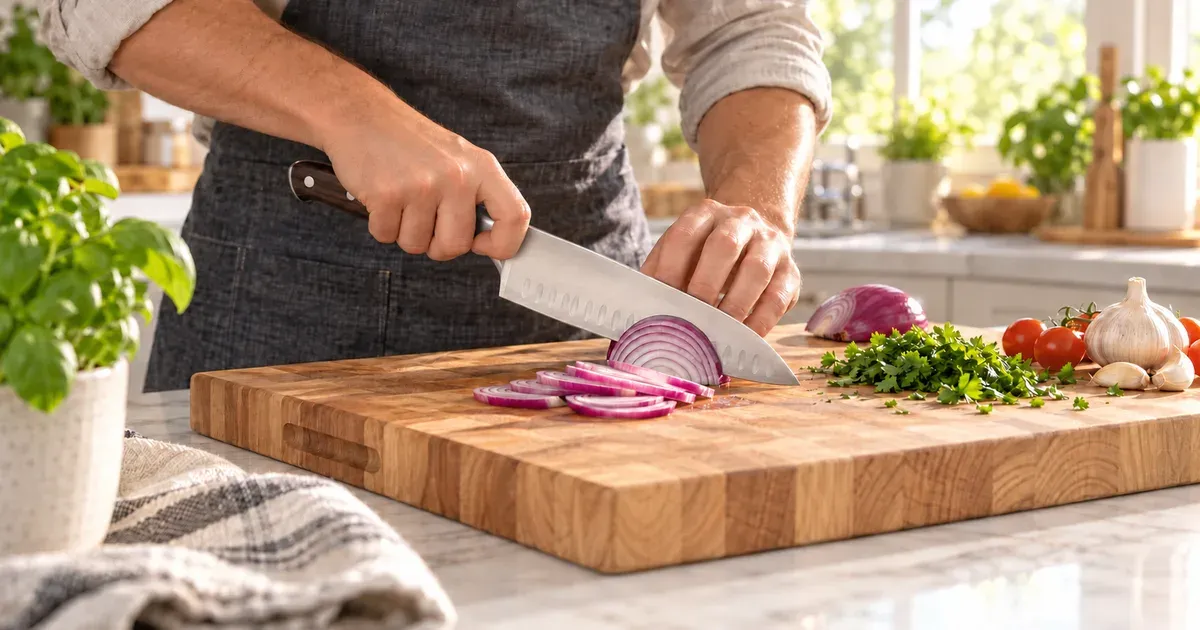
If you buy one good knife, make it an 8-inch chef’s knife. It chops onions, minces garlic and herbs, slices meat, breaks down a chicken, and splits a squash. Most home cooks reach for it for nine out of ten jobs, which is why many cooks would rather own one excellent chef’s knife than a block of mediocre ones.
Our top pick is the Mac Professional MTH-80. It’s a thin, very sharp Japanese-made blade with a Western-style handle, light enough for fast, precise cutting and tough enough for everyday use, for about $160. If you want something simpler and cheaper, the Victorinox Fibrox Pro is the knife professional kitchens and culinary schools have used for decades, for under $50. And if you like a heavier blade that powers through squash and chicken bones, the Wüsthof Classic is the German standard.
Our Picks at a Glance
| Knife | Best for | Style | Price |
|---|---|---|---|
| Mac Professional MTH-80 | Most cooks | Japanese blade, Western handle | About $160 |
| Victorinox Fibrox Pro | Value, beginners | Stamped, lightweight | About $48 |
| Wüsthof Classic | Heavy-duty prep, a classic feel | German, forged, full bolster | About $170 |
| Shun Classic | Gifts, thin precise cuts | Japanese, Damascus-clad | About $140 |
| Mercer Millennia | A first knife or a spare | Stamped, textured grip | About $21 |
Best Overall: Mac Professional MTH-80
Best overall
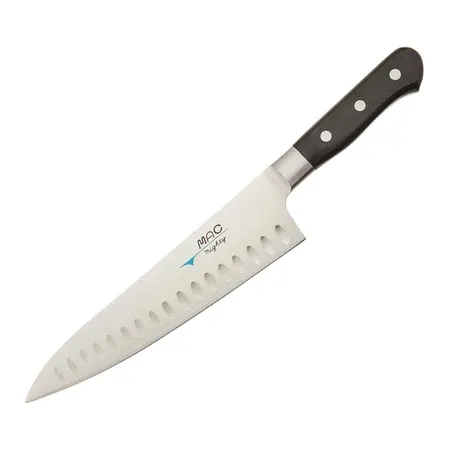
Mac Professional 8-Inch Chef's Knife (MTH-80)
A thin, sharp, Japanese-made 8-inch blade with dimples, a bolster, and a pakkawood handle.
The Mac MTH-80 sits between the two big knife traditions. The blade is Japanese: thinner and harder than a German knife, with a sharper edge that glides through onions, tomatoes, and herbs with little pressure. The handle is Western: a riveted pakkawood grip with a small steel bolster, so it feels familiar to anyone who has used a German knife.
The blade is about 2.5 millimeters thick at the spine and has a row of dimples along the edge, which help sliced potatoes and apples fall away instead of sticking. It’s light and balanced near the bolster, so it’s easy to control for long prep sessions, and its slightly curved belly works for both rocking and push-cutting.
Mac makes it in Seki, Japan’s knife-making center. Like most Japanese knives, its harder steel holds an edge longer than softer German steel but can chip if you twist it in bone or frozen food, and it needs hand washing and a ceramic honing rod or whetstone rather than a steel. It’s not a cleaver: use a heavier knife for splitting chicken backbones.
Buy it if you want one knife that’s noticeably sharper and more precise than what you’re using now, without the fussiness of a traditional Japanese blade.
Best Budget: Victorinox Fibrox Pro
Best budget
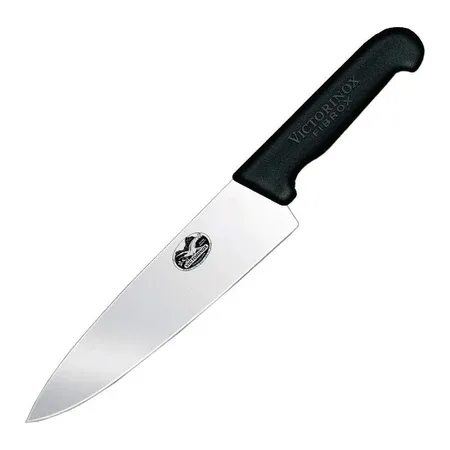
Victorinox Fibrox Pro 8-Inch Chef's Knife
A light, stamped Swiss chef's knife with a non-slip Fibrox handle, used in professional kitchens.
The Victorinox Fibrox Pro is one of the most-recommended kitchen knives ever made, and for good reason. It cuts nearly as well as knives costing three times as much, and it’s tough enough to survive years of daily use and the occasional mistake.
The blade is stamped from a thin sheet of high-carbon stainless steel rather than forged, which makes it light and keeps the price down. The Fibrox handle is a textured plastic that stays grippy even when wet or greasy, which is why it’s a fixture in restaurant kitchens and culinary schools. It’s made in Switzerland by the company behind the Swiss Army knife, and it has nearly 10,000 Amazon ratings averaging 4.7 stars.
The trade-offs are cosmetic. The handle looks utilitarian, and the softer steel needs honing more often than a Japanese blade. It’s also easy to sharpen, so a few passes on a pull-through sharpener or whetstone bring it right back.
Buy it if you want a great knife for under $50, are buying your first good knife, or want a workhorse you don’t have to baby.
Best German: Wüsthof Classic
Best german knife
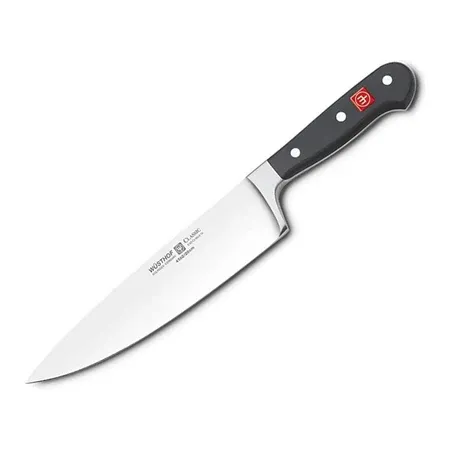
Wüsthof Classic 8-Inch Chef's Knife
A forged, full-tang German chef's knife with a full bolster and triple-riveted handle, made in Solingen.
The Wüsthof Classic is what most people picture when they think of a chef’s knife. It’s forged from a single piece of high-carbon stainless steel, with a full tang running through a triple-riveted handle and a thick bolster where blade meets handle. At about 8.5 ounces, it’s noticeably heavier than the Mac or Victorinox, and that weight does some of the work when you’re cutting through winter squash, a whole chicken, or a pile of carrots.
Wüsthof tempers the steel to 58 HRC, softer than Japanese knives, so the edge is less brittle and stands up to rough use, at the cost of needing more frequent honing. The curved blade suits the rocking motion many home cooks use for herbs and garlic. It’s made in Solingen, Germany, by a family-owned company that’s been making knives for more than 200 years.
The full bolster makes it harder to sharpen the very back of the blade, and the extra weight can tire your hand during long prep sessions. If you find it too heavy, Wüsthof’s Classic Ikon line has a lighter, half-bolster design.
Buy it if you like a solid, heavy knife and want one that will last decades.
Prefer a complete set? See our guide to the best knife sets.
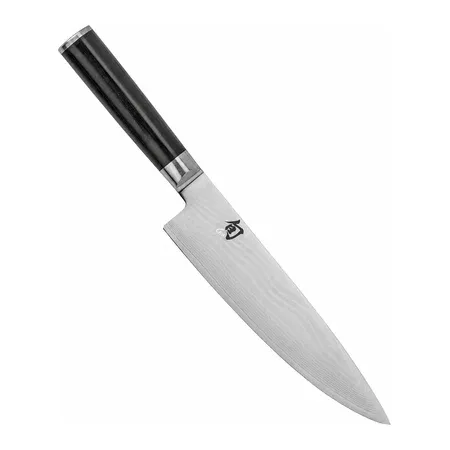
Best Japanese: Shun Classic
Best japanese knife
Shun Classic 8-Inch Chef's Knife
A VG-MAX steel core in 68 layers of Damascus cladding, with a 16-degree edge and a D-shaped handle.
The Shun Classic is the knife that introduced many American cooks to Japanese cutlery, and it’s still one of the best-looking knives you can buy. Its VG-MAX steel core is wrapped in 68 layers of Damascus cladding, which gives the blade its rippled pattern. The edge is sharpened to 16 degrees per side, sharper than a typical German knife, and the hard steel holds that edge for a long time.
The D-shaped pakkawood handle has a ridge that settles into your fingers, and it’s comfortable in either hand. Each knife is handcrafted in Seki, Japan, and Shun offers free sharpening for the life of the knife, which you can use by mailing it in.
Like the Mac, it’s hard and thin, so it can chip if you use it on bones or frozen food or twist it while cutting. Its blade is a bit flatter than a German knife’s, so it rewards push-cutting and slicing more than heavy rocking.
Buy it if you want a beautiful, very sharp Japanese knife, or a gift for someone who loves to cook.
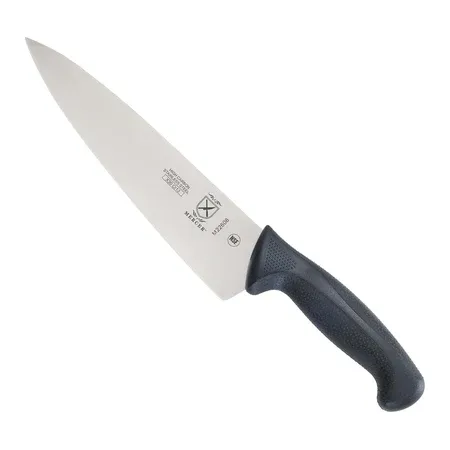
Best Under $25: Mercer Millennia
Best under $25
Mercer Culinary Millennia 8-Inch Chef's Knife
A stamped, high-carbon steel chef's knife with a textured non-slip handle for about $21.
Mercer Culinary knives are standard issue in many culinary schools, and the Millennia is the cheapest knife we’d actually recommend. It’s a stamped blade of high-carbon Japanese steel with a textured, rubbery handle that’s comfortable and secure, for about the price of a takeout dinner. It has more than 6,000 Amazon ratings averaging 4.7 stars.
It’s not as refined or as sharp out of the box as the Victorinox, and the handle is bulkier. But it’s a huge step up from a dull, cheap block-set knife, and it’s an easy choice for a college apartment, a camping kit, or a spare.
Buy it if you need a decent chef’s knife for as little as possible.
Japanese or German?
| Japanese | German | |
|---|---|---|
| Steel | Harder (about 60–61 HRC) | Softer (about 56–58 HRC) |
| Edge angle | Thinner, about 15–16° per side | About 14–20° per side |
| Weight | Lighter | Heavier |
| Sharpness | Sharper out of the box, holds an edge longer | Very sharp, but needs honing more often |
| Durability | Can chip with bones, frozen food, or twisting | Tougher, more forgiving |
| Blade shape | Flatter, suits push-cuts and slicing | More curved, suits rocking |
| Examples | Mac, Shun, Global | Wüsthof, Zwilling |
Neither style is better. Lighter Japanese knives feel quick and precise; heavier German knives feel solid and forgiving. The Mac is a good middle ground. If you can, hold a few in a store before you buy, since the handle and balance matter as much as the blade.
What to Look For
- Length. Eight inches is right for most home cooks. A 10-inch knife handles big melons and lots of prep but feels unwieldy on a small cutting board; a 6-inch knife suits small hands or small kitchens.
- Forged or stamped. Forged knives are hammered from a single bar of steel and usually have a bolster and more weight. Stamped knives are cut from a sheet and are lighter and cheaper. Both can be excellent: the stamped Victorinox outperforms many forged knives that cost more.
- Handle. It should feel secure with wet hands and not dig into your palm or fingers. Pakkawood, plastic, and composite handles are all fine; avoid untreated wood that can crack in water.
- Steel. Harder steel holds an edge longer but is more brittle. Stainless and “high-carbon stainless” blades resist rust; pure carbon-steel knives need to be dried immediately and develop a patina.
- Balance. Most cooks like a knife that balances near where the blade meets the handle.
How to Hold a Chef’s Knife
Use a pinch grip: pinch the blade just in front of the handle between your thumb and the side of your index finger, and wrap your other three fingers around the handle. It gives far more control than holding the handle like a hammer. On your other hand, curl your fingertips under into a “claw” and guide the blade along your knuckles.
How to Care for a Chef’s Knife
- Hand wash and dry it right away. Dishwashers dull and chip edges, and the heat and detergent damage handles.
- Use a wood or plastic cutting board. Glass, stone, and ceramic boards dull an edge almost instantly.
- Hone often, sharpen occasionally. A honing rod straightens the edge and should be used every few uses. Sharpening removes metal to make a new edge and is needed a few times a year. Use a ceramic honing rod on hard Japanese knives.
- Store it safely. A magnetic strip, an in-drawer block, or a blade guard keeps the edge from banging against other utensils.
A Chef’s Knife as a Gift
A good chef’s knife is one of the most-used gifts you can give a cook. The Shun Classic looks the part, the Wüsthof Classic comes from a name most cooks recognize, and the Mac is the one serious cooks often buy for themselves. Some cultures consider a knife an unlucky gift that “cuts” a relationship; a traditional fix is to include a coin that the recipient gives back, so they’ve technically bought the knife.
How We Chose
We compared well-known chef’s knives across Japanese, German, and budget styles on blade steel and hardness, edge angle and sharpness, weight and balance, handle comfort and grip, durability, ease of sharpening, maker reputation, owner ratings, and price. We focused on 8-inch knives because that’s the most useful size for home cooks.
Chef Knife FAQ
What is the best chef’s knife for a home cook?
The Mac Professional MTH-80 for most people. It’s sharper and more precise than a German knife but easy to use with a familiar Western handle. On a budget, the $48 Victorinox Fibrox Pro is excellent.
What size chef’s knife should I get?
Eight inches suits most home cooks and cutting boards. Choose 10 inches for lots of large prep, or 6 inches if you have small hands or a small kitchen.
Are expensive chef’s knives worth it?
Up to a point. A $50 Victorinox cuts very well. Spending $150 to $200 buys harder steel that stays sharp longer, better fit and finish, and a more comfortable handle. Beyond that, you’re mostly paying for looks and craftsmanship.
Is a Japanese or German knife better?
Neither. Japanese knives are lighter, thinner, and sharper but can chip. German knives are heavier and tougher. Choose based on how you cut and which feels better in your hand.
How often should I sharpen a chef’s knife?
Hone it every few uses and sharpen it two to four times a year, depending on how much you cook. If it slides off a tomato’s skin, it needs sharpening.
Can you put a chef’s knife in the dishwasher?
No. Dishwasher heat, detergent, and rattling dull the edge, can chip the blade, and damage the handle. Hand wash and dry it right away.