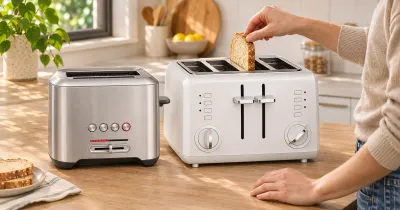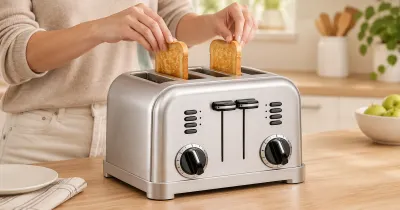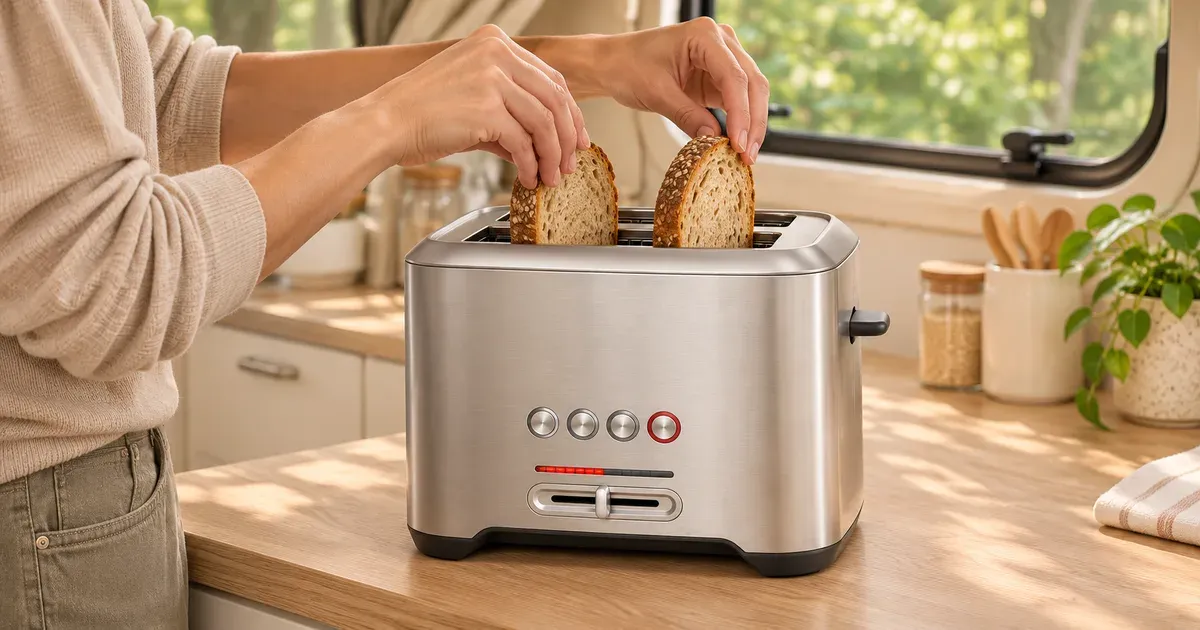
The short answer: size the inverter’s continuous rating comfortably above the toaster’s wattage. For an 850 to 1,100 W 2-slice toaster, that’s a 1,500 W continuous inverter; for an 1,800 W 4-slice toaster or a toaster oven, 2,000 W at minimum and 2,500 to 3,000 W to run it without straining the inverter. On a 12 V battery, a 900 W toaster pulls about 80 amps, and one 3-minute cycle uses about 4 amp-hours.
Inverter Size by Toaster Wattage
| Toaster (maker rating) | Watts | Minimum continuous inverter | Comfortable size |
|---|---|---|---|
| Hamilton Beach 22633G, Dash DST200 | 850 W | 1,000 W | 1,500 W |
| Cuisinart CPT-122, KitchenAid KMT2115, Breville BTA820 | 900 W | 1,200 W | 1,500 W |
| Dash DVTS501 Clear View | 1,100 W | 1,500 W | 2,000 W |
| Hamilton Beach 31403G Sure-Crisp toaster oven | 1,120 W | 1,500 W | 2,000 W |
| Panasonic NB-G110P FlashXpress toaster oven | 1,300 W | 1,500 W | 2,000 W |
| Revolution R90 / R180 Connect Plus | 1,440–1,500 W | 2,000 W | 2,500 W |
| Most 4-slice toasters and toaster ovens | 1,800 W | 2,000 W | 2,500–3,000 W |
Renogy’s guidance is to keep the inverter’s continuous output above the combined load with a margin of a couple hundred watts, and to plan on about 2,500 W of practical use from a 3,000 W unit. Its inverters reach peak efficiency at about two-thirds of rated capacity. If other loads (a fridge, a coffee maker) can run at the same time, add them in.
Read the Right Rating
- Continuous watts, not peak or surge. Inverters advertise a peak (surge) figure for a second or two of motor start-up. A toaster draws its full rating for the whole cycle, so only the continuous number counts.
- Watts, not VA. Some inverters are rated in volt-amps. Victron’s Phoenix 12/2000, for example, is a 2,000 VA unit listed at 1,600 W continuous. That runs a 900 W toaster but not an 1,800 W one.
- Toasters don’t need pure sine wave. A toaster’s heating elements are a resistive load, and Renogy notes that waveform quality doesn’t matter for simple heating loads. Toasters with digital controls or touchscreens (Revolution, Breville’s Die-Cast and Cuisinart’s motorized models) are safer on a pure sine wave inverter.
Battery Draw per Toasting Cycle
DC amps at 12 V = watts ÷ (12 × inverter efficiency). Victron lists 92% maximum efficiency for its 12 V Phoenix Smart inverters, used below. Amp-hours = amps × minutes ÷ 60.
| Toaster | 12 V current | One 3-minute cycle | Three cycles |
|---|---|---|---|
| 850 W | 77 A | 3.9 Ah (46 Wh) | 11.6 Ah |
| 900 W | 82 A | 4.1 Ah (49 Wh) | 12.2 Ah |
| 1,100 W | 100 A | 5.0 Ah (60 Wh) | 14.9 Ah |
| 1,800 W | 163 A | 8.2 Ah (98 Wh) | 24.5 Ah |
A toaster oven running 15 minutes at 1,800 W uses about 41 Ah (489 Wh) at 12 V, five times a toaster cycle. On a 24 V system, halve the current and amp-hours.
That current is the real constraint in a van: 80 to 160 amps of DC needs the battery cable gauge and fuse the inverter’s manual specifies, and a battery bank rated to deliver it. A 100 Ah lithium battery with a 100 A or higher continuous discharge rating handles a 900 W toaster; an 1,800 W toaster’s 163 A needs a battery or bank rated for that current. A small lead-acid starter battery isn’t built for either.
Lowest-Wattage Toasters
From maker or rating-plate listings:
- Pop-up: Hamilton Beach 22633G and Dash DST200 SmartStore, both 850 W. Cuisinart’s CPT-122 and KitchenAid’s KMT2115 are 900 W.
- Toaster oven: Hamilton Beach’s 31403G Sure-Crisp at 1,120 W, then Panasonic’s FlashXpress NB-G110P at 1,300 W.
A 4-slice toaster with independent controls draws about half its rating with only one side running, but the inverter still has to handle the full load if someone fills all four slots.
Generators
The same rule applies to a generator: its running watts (not starting watts) must exceed the toaster’s rating plus anything else plugged in. A 2,000 W inverter generator runs an 1,800 W toaster with little to spare.
Toaster Inverter FAQ
Will a 1,000 W inverter run a toaster?
Only a toaster rated under about 850 W, with nothing else connected. Most 2-slice toasters are 850 to 1,100 W, so a 1,500 W continuous inverter is the practical minimum.
Will a 2,000 W inverter run a toaster?
Yes, any 2-slice toaster and most 4-slice toasters up to 1,800 W, if 2,000 W is the continuous rating. A 2,000 W peak or 2,000 VA rating may be only about 1,000 to 1,600 W continuous.
How long can I run a toaster on a 100 Ah battery?
A 900 W toaster draws about 82 A at 12 V, so a 100 Ah lithium battery can run roughly 20 three-minute cycles before reaching about 80% depth of discharge. Lead-acid batteries deliver less usable capacity at high current.
Do I need a pure sine wave inverter for a toaster?
Not for a basic toaster with a mechanical lever: it’s a resistive load. Toasters with digital controls, touchscreens or motorized lifts are better on pure sine wave.
What size inverter for a toaster oven?
Most toaster ovens are 1,800 W, so 2,000 W continuous at minimum and 2,500 to 3,000 W to run comfortably. Lower-wattage ovens such as Hamilton Beach’s 1,120 W 31403G work on a 1,500 to 2,000 W inverter.
Sources
- Renogy: how to size an inverter (load and margin)
- Renogy: learn about inverters (efficiency at load)
- Renogy: 3,000 W inverter use cases (practical load)
- Renogy: what an inverter is and how it works in an RV (resistive loads)
- Victron Energy: Inverter Smart datasheet (PDF)
- Offgridtec: Victron Phoenix Inverter C12/2000 (2,000 VA, 1,600 W)
- Webstaurant: Hamilton Beach 22633G (850 W)
- Dash SmartStore 2-Slice Toaster (850 W)
- Hamilton Beach 31403G Sure-Crisp toaster oven (1,120 W)
- Webstaurant: Cuisinart CPT-122BKWH (900 W)