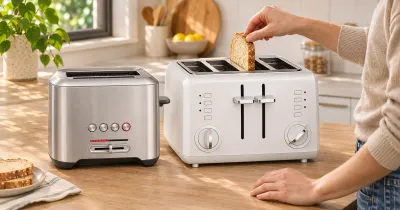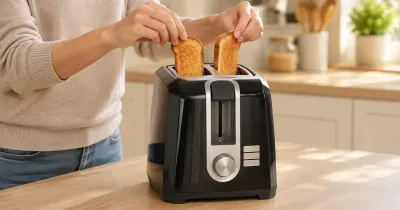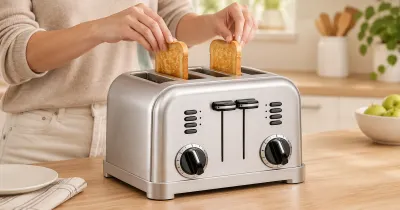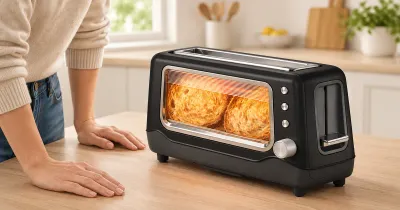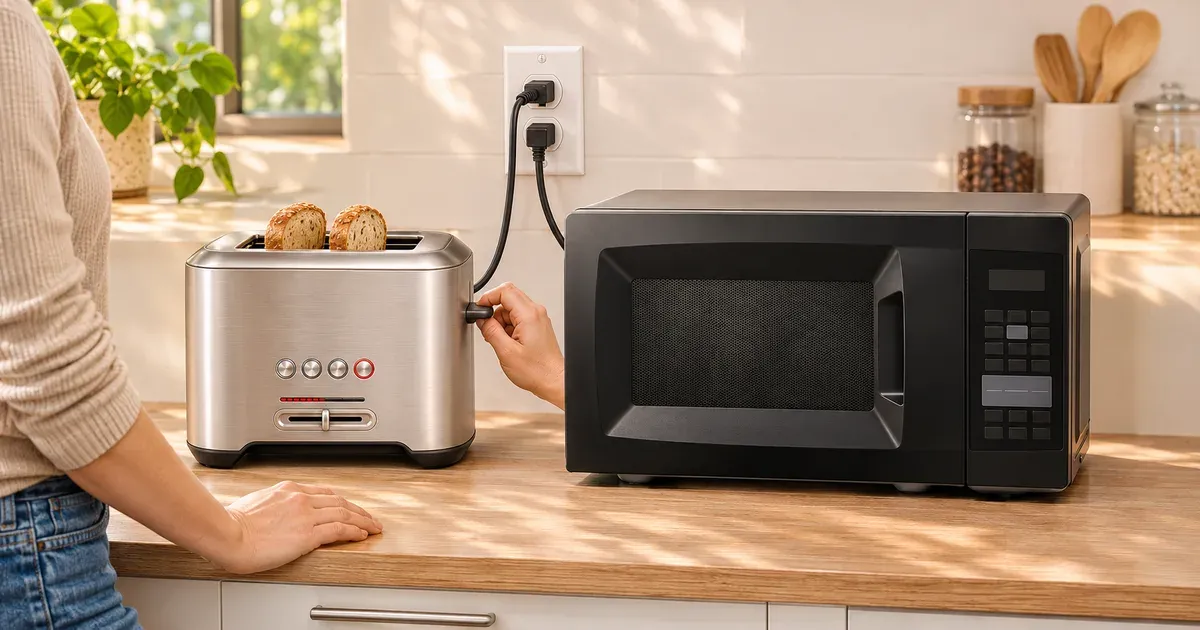
The short answer: they can share a circuit, but running both at the same time usually trips a 15 A breaker and often a 20 A one. A 2-slice toaster draws about 7.5 A and a 4-slice toaster up to 15 A; a countertop microwave draws about 9 to 13 A from the wall. Plug them into outlets on different kitchen circuits, or don’t run them together.
The Amp Math
Amps = input watts ÷ 120 V. Microwave figures are the input (power consumption) ratings from the makers, not the cooking watts on the box.
| Toaster | + Microwave | Combined | 15 A circuit | 20 A circuit |
|---|---|---|---|---|
| 900 W 2-slice (7.5 A) | LG MSER0990S, 1,040 W in (8.7 A) | 16.2 A | Over | OK |
| 900 W 2-slice (7.5 A) | Panasonic NN-SN67KS, 1,480 W in (12.4 A) | 19.9 A | Over | At the limit |
| 900 W 2-slice (7.5 A) | Toshiba EM131A5C, 1,550 W in (12.9 A) | 20.4 A | Over | Over |
| 1,400 W 4-slice (11.7 A) | LG MSER0990S (8.7 A) | 20.4 A | Over | Over |
| 1,800 W 4-slice (15 A) | Any countertop microwave | 23.7 A or more | Over | Over |
| 1,800 W toaster oven (15 A) | Any countertop microwave | 23.7 A or more | Over | Over |
A breaker doesn’t trip the instant a load crosses its rating; a modest overload can run for a while before the breaker opens. That’s why a toaster and microwave sometimes run together fine for a minute and trip on another day. Either way, the combination is over what the circuit is designed to carry.
For toaster ratings by model, see how many watts a toaster uses.
What the Electrical Code Requires
- At least two 20 A kitchen circuits. The National Electrical Code requires “two or more 20A, 120V small-appliance branch circuits” for kitchen, pantry and dining receptacles, and countertop receptacles “must be supplied by at least two small-appliance branch circuits.” That’s so a kitchen can run two heavy appliances at once, on different circuits.
- Per-outlet load limits. When a circuit has two or more receptacles, a 15 A receptacle may carry at most 12 A of cord-and-plug load and a 20 A receptacle at most 16 A. An 1,800 W toaster or toaster oven (15 A) is close to those limits on its own.
- GFCI protection. Kitchen countertop receptacles must be GFCI-protected, and recent editions of the code extend that to receptacles throughout the kitchen. A GFCI trips on current leaking to ground, not on overload, which matters when diagnosing trips (below).
Local adoption of code editions varies, and older homes may have 15 A kitchen circuits or a single circuit for the whole counter.
What the Makers Say
| Appliance | Maker requirement |
|---|---|
| Panasonic countertop microwaves | “The oven must be operated on a SEPARATE (dedicated) CIRCUIT. No other appliance should share the circuit with the microwave oven.” |
| Breville BMO850 microwave | Recommends “a separate circuit dedicated to serving only” the microwave. |
| GE countertop microwaves | A 120 V “individual” branch circuit on a 15 or 20 A breaker. |
| Ninja FO100 French door oven | A 15 A circuit with no other appliance running on it (Target listing). |
| Hamilton Beach 22633 toaster | “To avoid an electrical circuit overload, do not use another high-wattage appliance on the same circuit with this appliance.” |
So the toaster makers’ own instructions match the amp math: a toaster can share a circuit with lights and small loads, but not with a microwave, kettle or other high-wattage appliance running at the same time.
How to Fix It
- Find out which outlets share a circuit. Switch off one kitchen breaker and check which counter outlets go dead. Adjacent outlets are often on different circuits in newer kitchens, but not always.
- Put the toaster and the microwave on different circuits. If the counter has only one circuit, run one appliance at a time.
- Don’t use a power strip or extension cord to move a toaster or microwave. Panasonic allows only a three-wire grounded cord rated at or above the appliance, and Breville says not to use adapters.
- Add a circuit. If the kitchen has fewer than two 20 A counter circuits, an electrician can add one; that’s the code-standard fix.
Why Does My Toaster Trip the Breaker?
- Another appliance is running on the same circuit. By far the most common cause: a microwave, kettle, coffee maker or air fryer plus a toaster exceeds 15 or 20 A.
- The toaster alone exceeds the circuit. An 1,800 W toaster draws 15 A, the full rating of a 15 A circuit.
- A GFCI outlet trips, not the breaker. That points to current leaking to ground: a damaged cord, moisture, or crumbs and debris in contact with live parts. Unplug the toaster, let it cool, empty the crumb tray, and try a different outlet. If a GFCI trips with the toaster alone on several outlets, replace the toaster.
- A fault in the appliance. Panasonic’s recall of the FlashXpress NB-G200 toaster oven (July 2026) followed four reports of tripped breakers or outlets from a cord insulation defect. If an appliance trips a breaker on a circuit with nothing else running, stop using it and check toaster and toaster oven recalls.
Toaster and Microwave Circuit FAQ
Can a toaster and a microwave be plugged into the same outlet?
They can be plugged in, but both outlets of a duplex receptacle are on the same circuit, so running both at once draws 16 to 24 amps or more, enough to trip a 15 or 20 A breaker.
Does a toaster need its own circuit?
No, but Hamilton Beach’s manual says not to run another high-wattage appliance on the same circuit. A toaster needs a 120 V outlet with enough spare capacity: up to 15 A for an 1,800 W model.
How many amps does a toaster use?
About 7 to 8 A for a 2-slice toaster (850–1,000 W) and 12 to 15 A for a 4-slice toaster (1,400–1,800 W).
Can a toaster oven and a microwave share a circuit?
Not while both run. Most toaster ovens are 1,800 W (15 A), so adding any microwave exceeds a 20 A circuit.
Why does my toaster trip the GFCI outlet?
A GFCI trips on current leaking to ground rather than overload. Common causes are moisture, a damaged cord or crumbs touching live parts. If it trips on several outlets with nothing else running, the toaster has a fault.
Sources
- EC&M: NEC requirements for branch circuits (small-appliance circuits, 210.11(C)(1))
- California Title 8 §2360.4: receptacle ratings and loads, Table 210.21(B)(2)
- EC&M: kitchen GFCI requirements in the 2023 NEC
- Panasonic: recommended electrical requirements for microwaves
- Breville BMO850 manual (PDF)
- GE Appliances: microwave electrical requirements
- CPSC: Panasonic recalls electric toaster ovens (NB-G200), July 2026
- Hamilton Beach 22633 use and care guide (PDF)
- Webstaurant: Cuisinart CPT-180P1WH (1,800 W, 15 A)