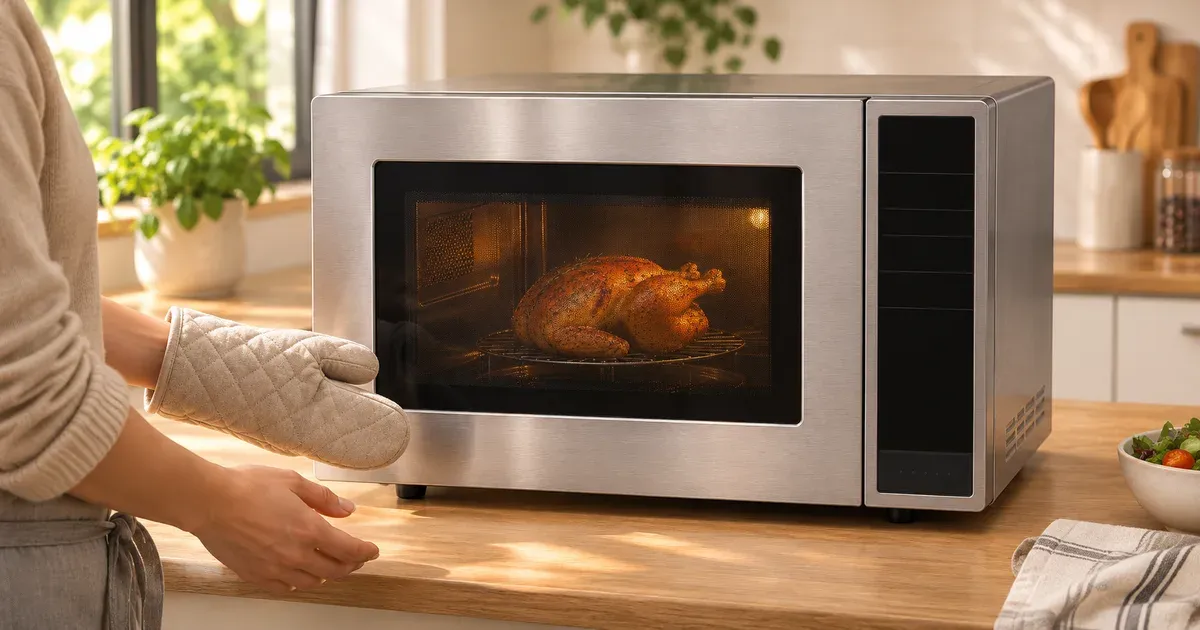
The short answer: a convection microwave is a microwave plus a small fan oven, so it can bake, roast and brown; a regular microwave only heats with microwaves. Get a convection model if it will replace or back up your oven (a small kitchen, an apartment, a second oven for holidays). Get a regular microwave if you mostly reheat and defrost: it’s cheaper, usually has more microwave power, and is simpler to clean. On November 19, 2026, a 1.5 cu ft Toshiba convection model cost $219.99, about $65 more than a 1.6 cu ft regular Toshiba.
Prices checked November 19, 2026. Amazon prices unless noted.
Convection vs. Regular at a Glance
| Convection microwave | Regular microwave | |
|---|---|---|
| Heat sources | Magnetron + heating element + fan (many add a grill/broil element) | Magnetron only |
| Can bake, roast, brown | Yes, typically 100–450°F | No |
| Air fry | On many newer models | No |
| Microwave power | Often 900–1,100 W | Commonly 1,000–1,250 W |
| Turntable/rack | Glass or metal turntable plus a metal rack | Glass turntable (or flatbed) |
| Cleaning | Grease from baking and air frying | Easier |
| Typical price | About $180–$700 countertop | About $90–$300 countertop |
What the Convection Element Adds
A convection microwave has a heating element at the back or top of the cavity and a fan that moves the hot air around, the same idea as the convection setting on a wall oven. That lets it:
- Bake and roast at set temperatures. Breville’s Combi Wave 3 in 1 runs convection from 100°F to 450°F, and Sharp’s SMC1585KS from 100°F to 450°F.
- Brown and crisp, which microwaves can’t do on their own.
- Combination cook. Microwaves and hot air at the same time. This is the main speed advantage: a small roast or casserole cooks faster than in a conventional oven but still browns.
- Air fry on most newer models (Toshiba ML-EC42P, GE GCST10A1WSS, Breville BMO870), which is just convection with a perforated basket or tray and a higher fan speed.
What You Give Up
Microwave power. Convection models usually have less microwave output than regular models of the same size and price, because the cavity and electrical budget are shared with a heating element.
| Model | Type | Capacity | Microwave output | Turntable | Price (Nov 19) |
|---|---|---|---|---|---|
| Toshiba ML-EC42P(SS) | Convection + air fry | 1.5 cu ft | 1,000 W | 13.6 in | $219.99 |
| Toshiba ML-EM45P(BS) | Regular | 1.6 cu ft | 1,200 W | 13.6 in | $154.58 |
| Sharp SMC1585KS | Convection (Carousel) | 1.5 cu ft | 900 W | 14.1 in ceramic | $699.00 |
| Sharp SMC1662KS | Regular | 1.6 cu ft | 1,100 W | 13.6 in | $198.97 |
| GE GCST10A1WSS | Convection + air fry | 1.0 cu ft | 1,050 W | 12.4 in | $199.00 |
| GE GCST16S1WSS | Regular | 1.6 cu ft | 1,150 W | 13.625 in | $179.00 |
| Breville Combi Wave BMO870 | Convection + air fry + grill | 1.1 cu ft | 1,100 W | 12.4 in | $499.95 |
Sharp’s spec sheet for the SMC1585KS lists “Output Power 1450W”, but that figure is the convection heater; the microwave is 900 W. Check for the “IEC” or “microwave” label next to a wattage before comparing.
Usable space. The metal rack and the need for air around the food take up height. A 1.5 cu ft convection oven fits a small whole chicken or an 8- or 9-inch pan, not a 9×13 casserole.
Simplicity. More modes and presets, a rack to store, and grease on the cavity walls after roasting or air frying.
Metal Racks and Pans
Convection microwaves are the one place metal is designed to go in a microwave. Use only the rack or pan supplied by the maker, and follow the manual on which modes allow it: most allow metal in convection and combination modes, not in microwave-only mode. USDA’s guidance adds that you should not use foil containers in an oven that “has metal shelves OR a metal turntable.”
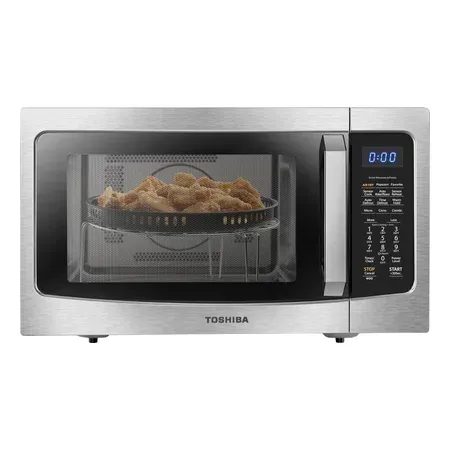
Best-Value convection microwave
Toshiba ML-EC42P(SS)
1.5 cu ft, 1,000 W microwave with convection, air fry and grill, plus a 13.6-inch turntable.
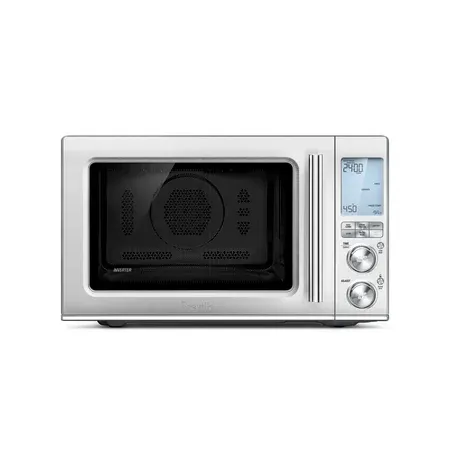
Best premium convection microwave
Breville Combi Wave 3 in 1 (BMO870)
1.1 cu ft, 1,100 W inverter microwave with convection (100–450°F), air fry and grill.
Which Should You Buy?
- Regular microwave if you have a working oven and use the microwave for reheating, defrosting and quick cooking. You get more watts and more cavity for the money. Start with the best microwaves.
- Convection microwave if you have no oven, a tiny oven, or want a second oven that preheats fast for small dishes. See the best convection microwaves.
- Convection plus air fry if you’d otherwise buy a separate air fryer and counter space is tight. Compare in microwave air fryer combo vs. air fryer.
- Built-in speed oven if you’re remodeling and want a second wall oven that also microwaves: see speed oven vs. convection microwave.
FAQ
What is the difference between a convection microwave and a regular microwave?
A convection microwave adds a heating element and a fan, so it can bake, roast and brown at oven temperatures (typically up to 450°F) as well as microwave. A regular microwave heats only with microwaves and can’t brown or crisp.
Can a convection microwave replace an oven?
For small households, mostly yes. It handles roasts, cookies, small casseroles and frozen foods. Capacity is the limit: a 1.5 cu ft convection microwave won’t take a 9×13 pan or a large turkey.
Do convection microwaves have less microwave power?
Often. Toshiba’s 1.5 cu ft convection ML-EC42P has 1,000 W of microwave power, while its 1.6 cu ft regular ML-EM45P has 1,200 W. Sharp’s 1.5 cu ft convection SMC1585KS has 900 W.
Can you put metal in a convection microwave?
Only the rack or pan supplied with it, and only in the modes the manual allows (usually convection and combination). In microwave-only mode, treat it like any microwave.
Is a convection microwave worth it?
It’s worth it if it replaces another appliance (a toaster oven, an air fryer or a missing second oven). If you have a good oven and only reheat, a regular microwave gives you more power and space for less money.
Sources
- Breville BMO870 product page and manual (PDF)
- Sharp SMC1585KS spec sheet (PDF)
- Sharp SMC1662KS spec sheet (PDF)
- Toshiba ML-EC42P(SS) product page
- Toshiba ML-EM45P product page
- GE GCST10A1WSS product page
- GE GCST16S1WSS product page
- USDA FSIS: Cooking with Microwave Ovens