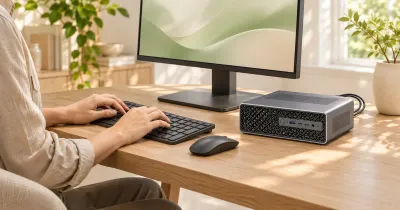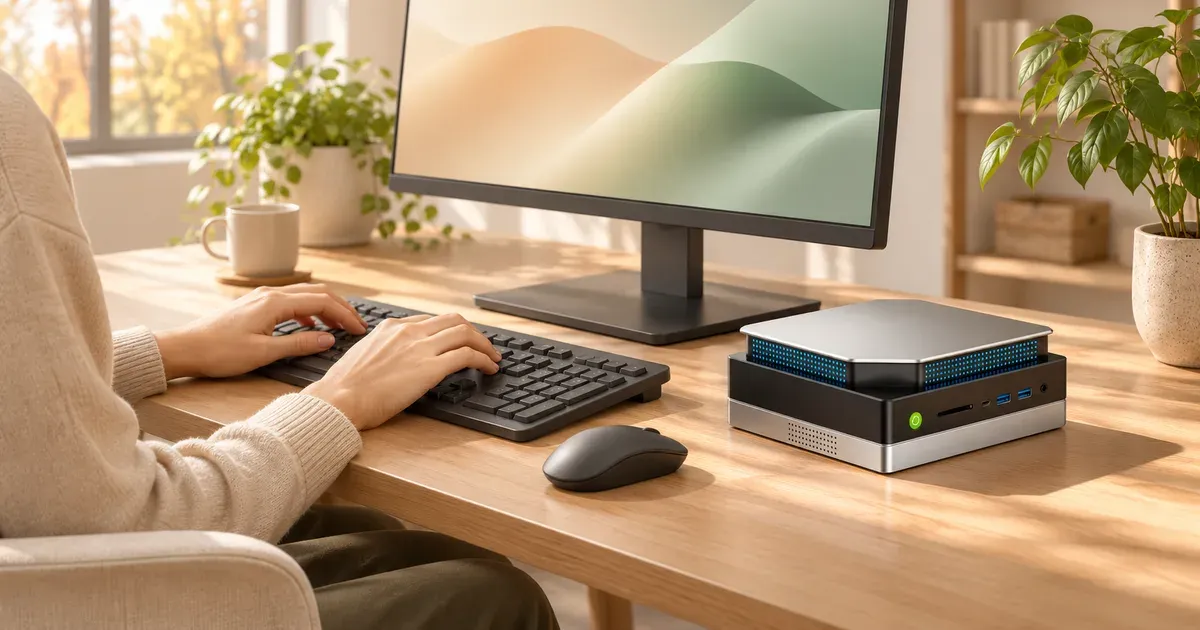
The short answer: a Ryzen AI Max+ 395 mini PC with 128GB of memory is the best mini PC for running local LLMs, and the GMKtec EVO-X2 is the one to buy. The 128GB model was $3,499.99 on Amazon on November 22, 2026. AMD lets you dedicate up to 96GB of that 128GB to the GPU on Windows (112GB addressable in total), and AMD’s own Linux guides configure 120GB. That’s enough to load 70B-parameter models at 4-bit quantization, which a normal graphics card can’t hold.
What decides LLM performance is how much memory the GPU can use and how fast that memory is, not CPU cores or NPU TOPS. Every Max+ 395 box runs the same chip on the same 256-bit LPDDR5x-8000 memory, so they differ mainly in price, ports, cooling and warranty. The alternatives:
- Mac mini M5 Pro: faster memory (307GB/s) in a quiet box, but 64GB at most.
- NVIDIA DGX Spark: 128GB plus NVIDIA’s CUDA software stack, at about twice the price.
- Bosgame M5: the cheapest 128GB Max+ 395 box here, at $3,099 with 2TB on Bosgame’s site.
- Framework Desktop: the same chip in a Mini-ITX case with a 5GbE port, when you can get one.
Local LLM Mini PCs Compared
| Mini PC | Chip | Memory | Bandwidth | GPU-usable memory | Price, Nov. 22 |
|---|---|---|---|---|---|
| GMKtec EVO-X2 | Ryzen AI Max+ 395 | 64 or 128GB LPDDR5x-8000, soldered | 256GB/s | 96GB dedicated (Windows), 120GB (Linux) | $2,199.99 (64GB), $3,499.99 (128GB) |
| Bosgame M5 | Ryzen AI Max+ 395 | 128GB, soldered | 256GB/s | same | $3,099 (128GB/2TB, Bosgame) |
| Framework Desktop | Ryzen AI Max+ 395 | 64 or 128GB, soldered | 256GB/s | same | $1,959 (64GB), $3,449 (128GB) DIY |
| Minisforum MS-S1 Max | Ryzen AI Max+ 395 | 64 or 128GB, soldered | 256GB/s | same | $2,599 (64GB), $3,959 (128GB) |
| Beelink GTR9 Pro | Ryzen AI Max+ 395 | 128GB, soldered | 256GB/s | same | $4,199 (Beelink), $4,299 (Amazon) |
| Mac mini M5 Pro | Apple M5 Pro | 24, 48 or 64GB unified | 307GB/s | unified, shared with the CPU | $1,549 (24GB, Amazon); 64GB from $3,199 (Apple) |
| NVIDIA DGX Spark | GB10 Grace Blackwell | 128GB LPDDR5x unified | 273GB/s | unified, with CUDA | $6,949.99 (Amazon) |
Bandwidth for the Max+ 395 is its 256-bit bus at 8000 MT/s. Apple and NVIDIA figures are from their spec pages.
Best Overall: GMKtec EVO-X2 (128GB)
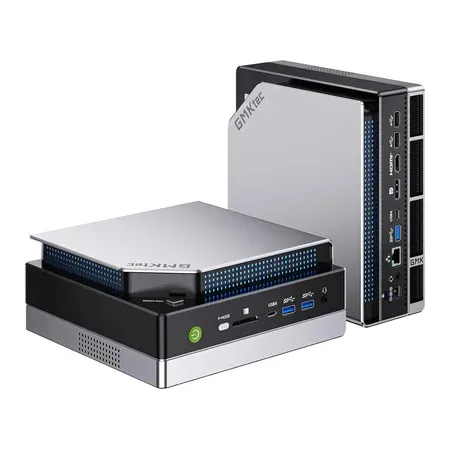
Best mini PC for local LLMs
GMKtec EVO-X2, Ryzen AI Max+ 395, 128GB LPDDR5X, 1TB SSD
16-core Ryzen AI Max+ 395 with the 40-CU Radeon 8060S and 128GB of 8000 MT/s memory. $3,499.99.
The EVO-X2 was the first widely sold Max+ 395 mini PC, and it’s still the cheapest 128GB box from a mini PC brand. It has two M.2 2280 PCIe 4.0 slots (up to 8TB each), USB4, HDMI 2.1, DP 1.4, Wi-Fi 7, one 2.5GbE port and a 230W external power brick. GMKtec sells it with 64GB or 128GB. The 96GB version its page still mentions isn’t sold in the US.
Get 128GB if LLMs are the reason you’re buying it. The memory is soldered, so you can’t add more later. The 64GB model ($2,199.99 on Amazon) gives the GPU up to 48GB, which fits 30B-class models comfortably but not 70B models at 4-bit.
GMKtec’s warranty is 1 year on the whole unit (plus 2 years on RAM, SSD and adapter for orders since October 1, 2026), and its own store takes returns within 7 days with a 15% restocking fee on opened units.
Best Value 128GB: Bosgame M5
Bosgame sells the M5 with a Ryzen AI Max+ 395 and 128GB of memory plus a 2TB SSD for $3,099 on its own store, $400 less than the 128GB EVO-X2 on Amazon with twice the storage. The 96GB version ($2,399) was sold out on November 22, 2026. It’s the same chip and memory as every other Max+ 395 box, so model capacity and speed match; you trade a better-known brand and Amazon returns for the lower price. Bosgame also sells an M5 MAX with the newer Ryzen AI Max+ PRO 495 and 192GB for $6,199.
Best for Linux: Framework Desktop
The Framework Desktop uses the same chip on a Mini-ITX board in a 4.5-liter case with a 400W internal power supply, a 120mm Noctua fan, 5GbE, two USB4 ports, HDMI 2.1 and two DisplayPort 2.1 ports. AMD used Framework Desktop nodes in its own article on running a trillion-parameter model across a cluster. After six memory-driven price increases in 2026, the DIY Edition is $1,959 with 64GB and $3,449 with 128GB on frame.work, sold in pre-order batches. Framework sells it only on its own site.
Best With 10GbE and a PCIe Slot: Minisforum MS-S1 Max
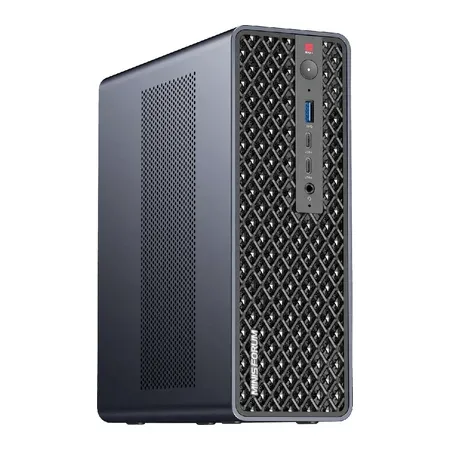
Best for clustering
Minisforum MS-S1 Max, Ryzen AI Max+ 395, 128GB, 2TB SSD
Two 10GbE RJ45 ports, two 80Gbps USB4 v2 ports, an internal PCIe slot and a 320W internal power supply. $3,959.
The MS-S1 Max is the Max+ 395 box for people who plan to link several. It has two 10GbE RJ45 ports, two USB4 v2 ports at 80Gbps on the back and two 40Gbps USB4 ports on the front. Inside is a PCIe x16 slot that runs at PCIe 4.0 x4. The second M.2 slot is only PCIe 4.0 x1. The 64GB “Local AI Pilot Edition” is $2,599 on Amazon. Minisforum’s 2-year warranty covers only purchases from its own US store, not Amazon.
Also Good: Beelink GTR9 Pro
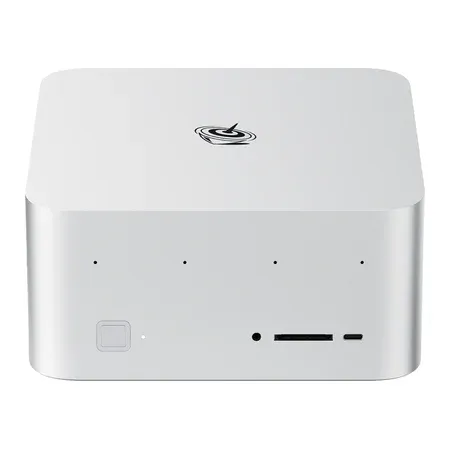
Best warranty
Beelink GTR9 Pro, Ryzen AI Max+ 395, 128GB, 2TB SSD
Two 10GbE ports, two USB4, DP 2.1 and HDMI 2.1, Wi-Fi 7, a built-in 230W power supply and a 3-year warranty. $4,299.
The GTR9 Pro costs more, but it has a built-in 230W power supply, two 10GbE ports, four display outputs and Beelink’s 3-year warranty. It’s $4,199 on Beelink’s own store during its Black Friday sale. Beelink also sells a GTR9 Pro with the newer Ryzen AI Max+ 495 and up to 192GB, from $4,799, shipped from China with duties paid by the buyer.
Best Quiet Option: Mac mini M5 Pro
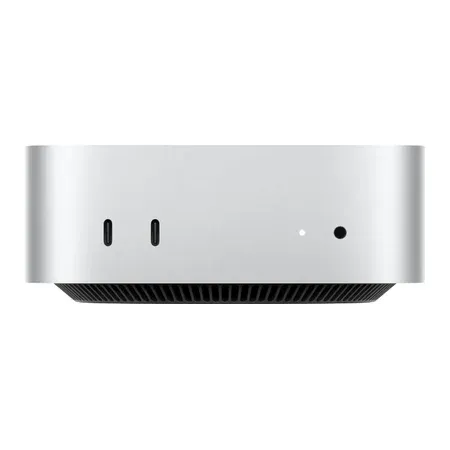
Best mac for local AI
Apple Mac mini (2026), M5 Pro, 24GB, 512GB
15-core M5 Pro with 307GB/s memory bandwidth. Configurable to 64GB at Apple. $1,549 on Amazon ($1,699 at Apple).
Apple’s M5 Pro has 307GB/s of memory bandwidth, more than any Max+ 395 box, so it generates text faster on any model that fits. The catch is size: the Mac mini M5 Pro tops out at 64GB, and only Apple sells that configuration (18-core CPU, 20-core GPU, 64GB, 1TB for $3,199). The 24GB model on Amazon runs 7B to 14B models well. For more memory on a Mac, the Mac Studio M5 Max goes to 128GB and the M5 Ultra to 512GB, starting at $2,499 and $5,499.
Most Memory: GMKtec EVO-X5 Pro
For models that don’t fit in 128GB, GMKtec’s EVO-X5 Pro uses AMD’s Ryzen AI Max+ PRO 495 with 192GB of soldered LPDDR5X-8533. It has two 10GbE ports, two 80Gbps USB4 v2 ports and two 40Gbps USB4 ports, three M.2 slots and a 330W power brick. It’s $6,799 with 2TB on gmktec.com. Beelink’s GTR9 Pro 495 (from $4,799) and Bosgame’s M5 MAX ($6,199) use the same chip.
Best for CUDA: NVIDIA DGX Spark
The DGX Spark pairs a 20-core Arm CPU with a Blackwell GPU and 128GB of unified LPDDR5x at 273GB/s, and it runs NVIDIA’s DGX OS (Ubuntu-based). Its advantage is software: CUDA, NVIDIA’s containers and fine-tuning tools work out of the box, and two units link through the built-in ConnectX-7 200Gb/s networking. It costs about twice what a 128GB Max+ 395 box does: $6,949.99 on Amazon on November 22, 2026, up from a $3,999 launch price. See DGX Spark vs. Ryzen AI Max+ 395.
New: RTX Spark compact desktops. On November 18, 2026, NVIDIA announced RTX Spark compact desktops from ASUS, Dell and MSI, with Acer, GIGABYTE, HP and Microsoft models coming. They’re Windows PCs with a 20-core NVIDIA Grace CPU, a Blackwell RTX GPU with 6,144 CUDA cores, up to 128GB of unified memory and 10GbE, and NVIDIA lists the ASUS ProArt GR1X mini PC among them. They bring the DGX Spark’s idea to Windows, with CUDA available for local AI and RTX acceleration for creative apps.
Can a Mini PC Run a 70B LLM?
Yes, if it has 64GB or more of memory the GPU can use. A 70B model quantized to 4 bits takes about 40GB, plus a few GB for the context window. That rules out 16GB to 48GB machines and fits a 128GB Max+ 395 box, a 128GB DGX Spark or a 64GB Mac mini M5 Pro (with less room for context).
Speed is the catch. Each generated token reads the whole model from memory, so the ceiling is roughly memory bandwidth divided by model size:
| Machine | Bandwidth | Ceiling for a 40GB model |
|---|---|---|
| Ryzen AI Max+ 395 (any brand) | 256GB/s | about 6 tokens per second |
| NVIDIA DGX Spark | 273GB/s | about 7 tokens per second |
| Mac mini M5 Pro (64GB) | 307GB/s | about 8 tokens per second |
Real speeds land below these ceilings. That’s readable, but slow for long answers. Mixture-of-experts models, which read only part of their weights per token, run much faster on the same hardware. AMD says Adrenalin 25.8.1 lets a 128GB Max+ 395 run models up to 128 billion parameters in llama.cpp on Windows.
The full memory math by quantization is in can a mini PC run a 70B LLM.
What to Look For
Memory first. Buy the most memory you can afford, because every box here has soldered memory. On Strix Halo, 64GB gives the GPU up to 48GB, and 128GB gives it 96GB on Windows.
Bandwidth second. It sets tokens per second. All Max+ 395 boxes share 256GB/s. A cheaper Ryzen AI 9 HX 370 mini PC with DDR5 SO-DIMMs has far less bandwidth and a smaller GPU, so it suits small models only.
Software. Ollama, LM Studio and llama.cpp run on all of these. CUDA-only tools need the DGX Spark or a PC with an NVIDIA card.
Not the NPU. NPU TOPS figures (50 TOPS on the Max+ 395) don’t drive LLM speed in the common runtimes. The GPU does the work.
Local LLM Mini PC FAQ
What is the best mini PC for running local LLMs?
The GMKtec EVO-X2 with 128GB ($3,499.99 on Amazon on November 22, 2026). Its Ryzen AI Max+ 395 can give the GPU up to 96GB on Windows and 120GB on Linux, enough for 70B models at 4-bit.
Is the Mac mini good for local LLMs?
The M5 Pro model is. It has 307GB/s of memory bandwidth and up to 64GB. The M6 model has 153 to 170GB/s and 32GB at most, which limits it to small models.
How much RAM do I need for a local LLM?
About 6GB for a 7B model at 4-bit, 20GB for a 30B model and 40GB for a 70B model, plus room for context and the operating system.
Is the DGX Spark worth it over a Ryzen AI Max+ 395 mini PC?
For CUDA development and NVIDIA’s tools, yes. For running models with Ollama or LM Studio, a 128GB Max+ 395 box gives similar memory and bandwidth for about half the price.
Can I upgrade the RAM in a Ryzen AI Max+ 395 mini PC later?
No. AMD lists only soldered LPDDR5x for Ryzen AI Max chips, so the memory you buy is the memory you keep.
Sources
- AMD: Variable Graphics Memory and AI model sizes FAQ
- AMD: Ryzen AI Max+ runs up to 128B-parameter LLMs in LM Studio
- AMD: running a one-trillion-parameter LLM locally
- AMD Ryzen AI Max+ 395 specifications
- GMKtec EVO-X2
- Framework Desktop
- Minisforum MS-S1 Max
- Beelink GTR9 Pro
- Apple Mac mini specs and Mac Studio specs
- NVIDIA DGX Spark and NVIDIA: RTX Spark compact desktops out now
- Bosgame M5
- GMKtec EVO-X5 Pro