The short answer: a bidet in your own home is sanitary if you keep the nozzle clean, and it leaves far fewer germs on your hands than wiping alone. In a 2022 study, wiping after using a bidet left about 4,100 microbes on a glove against about 39,500 without one, roughly 90% fewer. The weak spot is the nozzle: 87% of the bidet nozzles in one Japanese hospital carried bacteria, including drug-resistant strains. Large Japanese cohorts found no increase in urinary tract infections, but one study of women with symptoms linked habitual use to fewer protective lactobacilli in vaginal flora. No systematic review covers bidets and infection, so all of this comes from individual studies.
Bidets vs. Toilet Paper: Hand Hygiene
| Study | What was measured | Result |
|---|---|---|
| Hand contamination study, 2022 | 32 nursing students wiped with four layers of paper after a bowel movement, with or without a bidet first; microbes counted on an outer glove | 39,499 cfu per glove without a bidet vs. 4,147 with one (average) |
That’s the main hygiene benefit with evidence behind it: less fecal material reaches your hands. It’s one small study, and participants chose their own bidet settings.
Are Bidet Nozzles Dirty?
| Study | Setting | Finding |
|---|---|---|
| Hospital survey, 2017 | All 292 electric bidet seats in a Japanese university hospital | 254 nozzles (86.9%) were contaminated, including MRSA on one nozzle and ESBL-producing E. coli |
| Campus survey, 2016 | 127 tank-type seats in university restrooms | Spray water met tap-water standards for total microbes but had less chlorine than the tap. Bacteria from the tap water multiplied inside the warm tanks and nozzle pipes |
| Tank vs. tankless, 2018 | Long-term campus survey | Total microbe counts in the spray were low for both tank and tankless (instant) seats; biofilm bacteria were higher inside the units |
| Nozzle cleaning, 2022 | Lab model plus campus surveys | Microbes didn’t travel back from the nozzle into the tank. Daily nozzle cleaning lowered counts in the spray |
| Electrolyzed water, 2022 | Lab model, tank and tankless seats | Self-cleaning with neutral electrolyzed water cut P. aeruginosa and E. coli in the spray compared with tap water |
What this means at home: public and hospital bidets are shared by many people, which is where resistant bacteria showed up. A 2021 review advises that hospital patients with weakened immunity be cautious about shared bidets (2021). At home, cleaning the nozzle regularly is what the evidence supports. TOTO’s EWATER+ and Kohler’s E835 use electrolyzed water, which matches the lab study above, but no study has tested those specific seats.
Can a Bidet Cause a UTI?
The best evidence says no increase. Two web-panel cohorts in Japan followed bidet users and non-users:
- 1-year cohort, 7,637 people (2017): new urological infections weren’t higher among bidet users. New bacterial vaginitis symptoms were (adjusted odds ratio 2.66, 95% CI 1.32 to 5.52), but the authors say the cases were too few to draw a conclusion.
- 3-year follow-up, 10,305 people at baseline (2018): habitual use didn’t increase the cumulative incidence of hemorrhoids or urogenital infections.
Both are observational surveys, so they can’t rule out a small effect. No randomized trial or systematic review has tested bidets and UTIs. If you get UTIs, use the front (feminine) nozzle or wash front to back, and keep the nozzle clean.
Do Bidets Affect Vaginal Flora?
| Study | Who | Finding |
|---|---|---|
| Vaginal microflora study, 2010 | 268 women with increased vaginal discharge | Lactobacilli were absent in 42.9% of habitual bidet users vs. 8.8% of non-users, and fecal bacteria were found mostly in users. The sample was women with symptoms, so it can’t show cause |
| Pregnancy study, 2013 | 1,293 women who gave birth in Tokyo | No link with preterm birth (adjusted OR 1.04, 0.72 to 1.48) or bacterial vaginosis (adjusted OR 0.96, 0.70 to 1.33) |
| High-risk pregnancy study, 2019 | 204 women with high-risk pregnancies | Bidet users had more abnormal vaginal colonization (60.7% vs. 44.2%), more E. coli (13.1% vs. 3.3%) and more preterm births before 37 weeks (87.3% vs. 73.0%). Observational, high-risk patients only |
The concern in these studies is habitual washing of the vaginal area with the bidet stream, not occasional use. Most electric seats have a separate front nozzle with a gentler spray. If you have recurring vaginal infections or a high-risk pregnancy, ask your doctor before using the front wash regularly.
How to Keep a Bidet Sanitary
- Clean the nozzle weekly. Most electric seats extend the wand for cleaning from the remote or side panel. Wipe it with a soft cloth and mild cleaner; harsh chemicals can void TOTO’s warranty.
- Use self-cleaning features. Nearly every seat rinses the nozzle before and after use. Electrolyzed-water cleaning (TOTO EWATER+, Kohler E835, Alpha JX Elite) has lab support.
- Prefer instant heat over a tank if you’re buying. Tanks hold warm water where bacteria can grow. See instant vs. tank bidet water heater.
- Don’t share in a health-care setting if someone has a weakened immune system.
- Replace filters on schedule; many seats have an inlet filter.
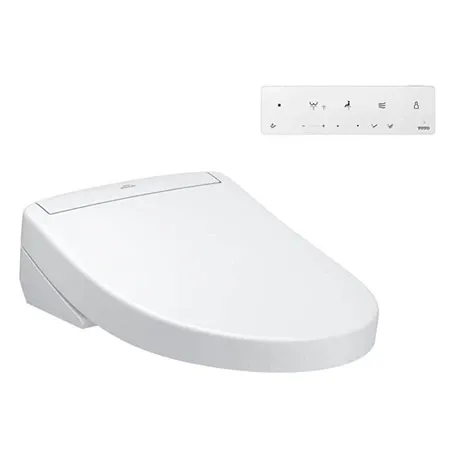
Instant heat with EWATER+ wand cleaning
TOTO Washlet S5 (SW3446, elongated)
Instant warm water (no tank), self-cleaning wand treated with electrolyzed water, PREMIST bowl spray and a dryer.
The S5 was $548.89 on Amazon on November 18, 2026. More seats are in best bidet toilet seats.
Are Bidets Sanitary FAQ
Are bidets more hygienic than toilet paper?
For your hands, yes. In a 2022 study, wiping after a bidet left about 4,100 microbes on a glove against about 39,500 after paper alone. The bidet itself needs its nozzle cleaned to stay hygienic, especially when it’s shared.
Does the bidet nozzle get dirty?
Yes. In a Japanese hospital, 87% of 292 bidet nozzles carried bacteria, some drug-resistant. At home, the self-rinse helps, and daily or weekly nozzle cleaning lowered bacteria in the spray in a 2022 study. Electrolyzed-water cleaning reduced E. coli and P. aeruginosa in a lab model.
Can a bidet cause a UTI?
Studies haven’t shown that. Japanese cohorts of 7,637 and 10,305 people found no increase in urinary or urogenital infections among bidet users. Those are observational surveys, and no trial has tested it directly.
Can bidets harm vaginal flora?
Possibly, with habitual front washing. A 2010 study of 268 women with discharge found lactobacilli absent in 42.9% of habitual users against 8.8% of non-users. A larger 2013 study of pregnant women found no link with bacterial vaginosis or preterm birth.
Are bidets safe during pregnancy?
A 2013 Tokyo study of 1,293 women found no link between bidet use and preterm birth or bacterial vaginosis. A 2019 study of 204 high-risk pregnancies found more abnormal vaginal bacteria and more preterm births among users. If your pregnancy is high-risk, ask your obstetrician about using the front wash.
Sources
- Hand contamination with and without a bidet (2022)
- Nozzle and water studies: hospital (2017), campus tanks (2016), tank vs. tankless (2018), nozzle cleaning (2022), electrolyzed water (2022)
- Infection cohorts: 1-year (2017), 3-year (2018)
- Vaginal flora and pregnancy: 2010, 2013, 2019
- Review: bidet use, anal symptoms and hospital infection (2021)